In this guide, we draw from real client work and first-hand experience to show you how to surface the strengths, differentiators, and customer insights hiding in plain sight. You’ll learn the same resource-light methods we use internally to help growing brands sharpen their message, clarify their identity, and communicate value in a way that resonates immediately.
If you’re ready to uncover what truly sets you apart using practical steps that work even on the tightest budgets, this is the playbook refined from years of brand-building experience. As you explore how to find your UVP with clarity and confidence, you’ll also gain a deeper understanding of what is brand positioning and why it matters in the process.
Quick Answers
What is brand positioning?
Brand positioning is how your brand claims a distinct spot in your audience’s mind. At Branded Agency, we define it as the clear, consistent message that tells people why you’re the obvious choice—especially in a crowded market. It’s the foundation that shapes every touchpoint, keeps your messaging aligned, and helps your brand stand out with purpose and clarity.
Top Takeaways
Your UVP already exists — uncover it, don’t invent it.
Limited resources can sharpen clarity and differentiation.
Customer feedback reveals what makes you truly valuable.
Consistent messaging across all touchpoints builds trust.
A strong UVP helps you stand out and compete effectively.
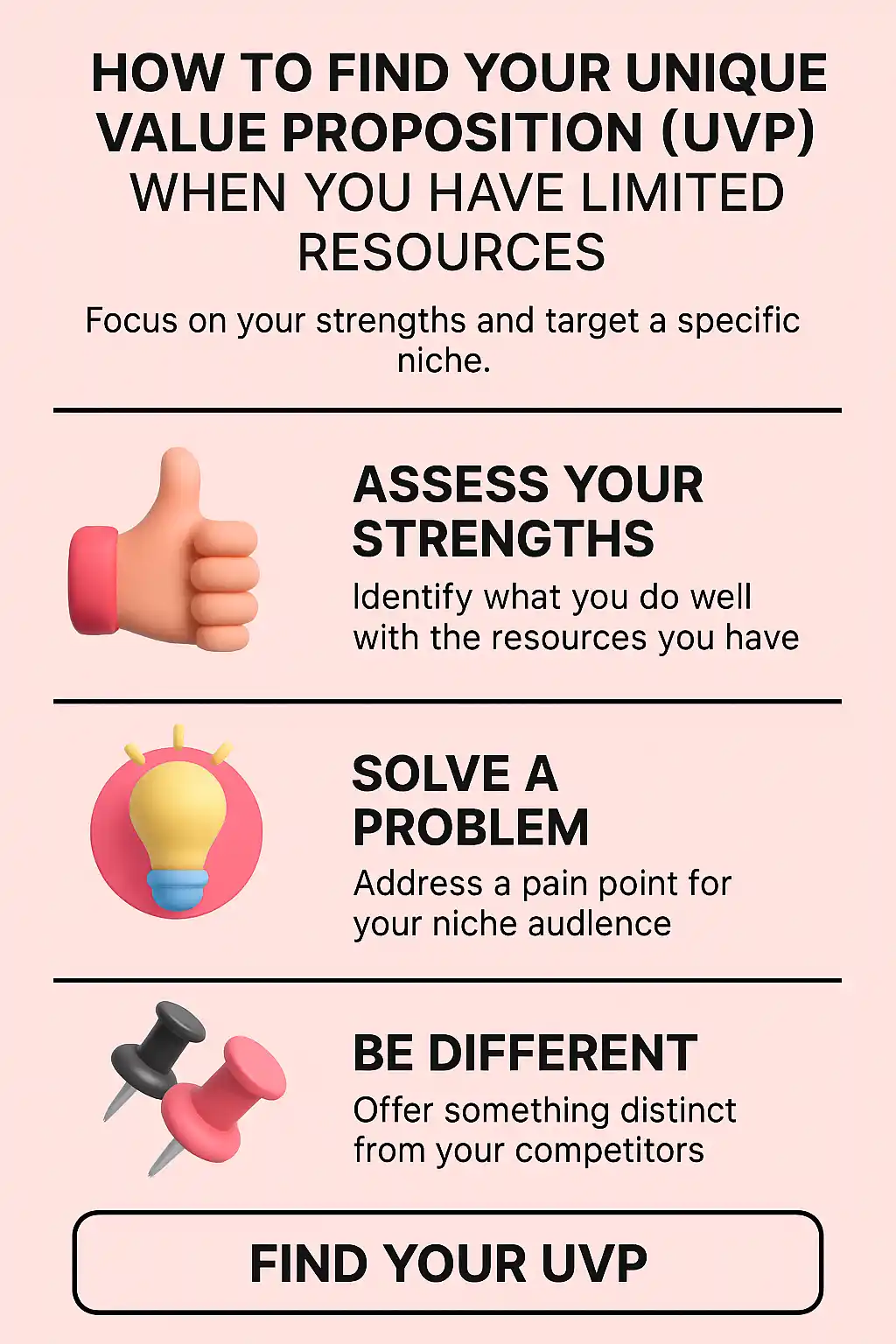
A strong Unique Value Proposition (UVP) clearly explains why someone should choose your brand over any alternative—and you don’t need a large budget to uncover it. What you do need is a clear understanding of your strengths, your audience, and the specific problem you solve better than others.
Start by identifying what you already do well. Review customer feedback, common compliments, repeat requests, or the tasks clients rely on you for most. These small patterns often reveal powerful differentiators. Next, look at your competitors. With limited resources, this can be as simple as scanning their websites and social profiles to note what they emphasize—and, more importantly, what they overlook. The gaps they leave open often point directly to your unique advantage.
From there, connect your strengths to what your audience values most. A UVP isn’t about listing features; it’s about communicating the outcome your customers actually care about. Ask: What result can we consistently deliver that others don’t? When you can answer this in a single clear sentence, you’re close to your UVP.
Finally, validate your UVP quickly and inexpensively. Share a draft with customers, test it in a social post, or include it in a simple landing page. If people respond with clarity (“I get it”), alignment (“This is exactly what I need”), or curiosity (“Tell me more”), you’re on the right track.
Finding your UVP with limited resources isn’t about doing more—it’s about focusing on what matters. When you narrow your message to the value only you provide, you create a stronger, more memorable brand without overspending.
"In every brand we’ve worked with—from one-person startups to lean teams scaling on tight budgets—their strongest UVP was never something they had to invent. It was already there, hidden in the way they uniquely solve problems for real people. Our job is simply to surface it, shape it, and help them see the value they’ve been delivering all along."
Essential Resources to Strengthen Your Brand Positioning Strategy
Below is a curated list of the most valuable resources we recommend at Branded Agency—organized for clarity, quick decision-making, and the way real founders and small teams actually research. Each pick reflects the tools, references, and guides we point clients to when they're defining or refining their brand positioning.
1. DigitalOcean: Your No-Fluff Primer on What Brand Positioning Really Means
Why we recommend it: DigitalOcean gives you a grounded, easy-to-digest breakdown of brand positioning without the jargon. It’s the kind of resource we share with clients when we need everyone aligned on core definitions fast.
Source: https://www.digitalocean.com/resources/articles/what-is-brand-positioning
2. The Branding Journal: A Clean, Definitive Definition You Can Build On
Why we recommend it:
This guide cuts straight to the essentials and helps you get crystal clear on what positioning is—and what it isn’t. We often use it as a baseline reference before tailoring a custom positioning strategy.
Source: https://www.thebrandingjournal.com/2016/11/brand-positioning-definition/
This guide cuts straight to the essentials and helps you get crystal clear on what positioning is—and what it isn’t. We often use it as a baseline reference before tailoring a custom positioning strategy.
3. Amazon Ads Guide: Positioning Explained Through Real Customer Value
Why we recommend it: Amazon frames positioning with a strong customer-value lens, which aligns with how we help clients articulate the outcomes they deliver. Great for product-led brands seeking clarity on differentiation.
Source: https://advertising.amazon.com/library/guides/brand-positioning
4. Capterra: Practical Positioning Types You Can Apply Immediately
Why we recommend it: We like this resource because it translates positioning theory into practical strategy options. If you're unsure how to position your brand, this is a solid starting point for identifying your direction.
Source: https://www.capterra.com/resources/brand-positioning/
5. Adobe Express: A High-Level View of Different Positioning Angles
Why we recommend it: Adobe’s overview is helpful when you’re weighing multiple angles—price, lifestyle, convenience, service—and need to see which aligns best with your strengths. It’s a quick way to spark strategic clarity.
Source: https://www.adobe.com/express/learn/blog/brand-positioning
6. Map & Fire: A Framework That Mirrors How We Guide Clients
Why we recommend it: Map & Fire offers a structured framework similar to what we use during brand strategy sessions. It’s excellent for founders who want a guided, step-by-step process to define their UVP and positioning.
Source: https://mapandfire.com/field-guide/brand-positioning-strategy/
7. How Brands Are Built: The Mind-Space Concept Behind Memorable Brands
Why we recommend it: This conceptual perspective helps you understand positioning at a deeper, strategic level—how brands earn space in a customer’s mind. We reference this when clients want to build a long-term, defensible position.
Source: https://howbrandsarebuilt.com/definition-of-brand-positioning/
Supporting Statistics
At Branded Agency, we see every day how a clear UVP directly impacts survival, growth, and competitiveness. These data points reinforce what we experience with clients — and they come from credible, U.S.-based sources.
1) Small Business Competition is Massive
There are 36.2 million small businesses operating in the U.S. (2025).
That makes the marketplace extremely crowded — making a sharp, clear UVP essential for standing out.
Source: Office of Advocacy
There are 36.2 million small businesses operating in the U.S. (2025).
That makes the marketplace extremely crowded — making a sharp, clear UVP essential for standing out.
2) Only a Fraction Survive Long-Term Without Clarity
Just 34.7% of business establishments born in 2013 were still operating in 2023.
From our work with clients: those who survive and thrive tend to have clearly defined value propositions and consistent messaging.
Source: Bureau of Labor Statistics
Just 34.7% of business establishments born in 2013 were still operating in 2023.
From our work with clients: those who survive and thrive tend to have clearly defined value propositions and consistent messaging.
3) Focused Positioning — Not Size — Drives Breakout Growth
Firms owned by Black entrepreneurs saw 66% revenue growth between 2017 and 2022.
In practice, this shows that with clear positioning and a strong offering, even underrepresented or smaller firms can achieve significant growth and market momentum.
Source: Pew Research Center
Firms owned by Black entrepreneurs saw 66% revenue growth between 2017 and 2022.
In practice, this shows that with clear positioning and a strong offering, even underrepresented or smaller firms can achieve significant growth and market momentum.
Final Thoughts & Opinion
Key Takeaways
Brand positioning is more than messaging — it’s the foundation that shapes how customers interpret your value.
Strong positioning drives trust, consistency, and differentiation.
Weak or unclear positioning leads to confusing marketing and missed opportunities.
Brand positioning is more than messaging — it’s the foundation that shapes how customers interpret your value.
Strong positioning drives trust, consistency, and differentiation.
Weak or unclear positioning leads to confusing marketing and missed opportunities.
Why It Matters
Builds recognition — customers understand exactly what you stand for.
Strengthens marketing cohesion — every channel speaks one unified message.
Creates competitive edge — especially in saturated markets where sameness is the norm.
Builds recognition — customers understand exactly what you stand for.
Strengthens marketing cohesion — every channel speaks one unified message.
Creates competitive edge — especially in saturated markets where sameness is the norm.
What We’ve Seen Firsthand
Many businesses struggle not because they lack talent, but because their value is communicated inconsistently.
When brands clarify their position, they typically see:
Faster customer understanding
Higher engagement
Better conversion rates
The biggest shifts happen when brands stop trying to compete on “everything” and choose one distinct value they can own confidently, a focus that strengthens their brand extension strategy and long-term growth.
Many businesses struggle not because they lack talent, but because their value is communicated inconsistently.
When brands clarify their position, they typically see:
Faster customer understanding
Higher engagement
Better conversion rates
The biggest shifts happen when brands stop trying to compete on “everything” and choose one distinct value they can own confidently, a focus that strengthens their brand extension strategy and long-term growth.
Our Professional Perspective
Brand positioning works best when it reflects lived expertise, not generic statements.
Businesses who lean into their authentic strengths—not trends—develop the most sustainable brand presence.
Positioning isn’t a one-time exercise. It evolves with your growth, market shifts, and customer behavior.
Brand positioning works best when it reflects lived expertise, not generic statements.
Businesses who lean into their authentic strengths—not trends—develop the most sustainable brand presence.
Positioning isn’t a one-time exercise. It evolves with your growth, market shifts, and customer behavior.
Next Steps
Clarify Your Brand Position
Define your core value.
Identify what sets you apart.
Create a one-sentence positioning statement.
Audit Your Brand Touchpoints
Review your website, social channels, and marketing assets.
Spot inconsistencies.
Note areas where your message is unclear.
Gather Customer Insights
Ask customers what you do best.
Look for repeated themes.
Use insights to refine your position.
Define Your Ideal Audience
Identify your target customer.
Outline their needs, pains, and motivations.
Align your brand position with their priorities.
Build Supporting Messaging
Create a tagline, promise, and key message pillars.
Keep tone and language consistent.
Test messaging before rollout.
Update Your Assets
Refresh website copy and service descriptions.
Align social bios and content themes.
Ensure consistent voice and visuals.
Monitor & Improve
Track audience response and engagement.
Measure clarity and conversions.
Adjust positioning as needed.
Clarify Your Brand Position
Define your core value.
Identify what sets you apart.
Create a one-sentence positioning statement.
Audit Your Brand Touchpoints
Review your website, social channels, and marketing assets.
Spot inconsistencies.
Note areas where your message is unclear.
Gather Customer Insights
Ask customers what you do best.
Look for repeated themes.
Use insights to refine your position.
Define Your Ideal Audience
Identify your target customer.
Outline their needs, pains, and motivations.
Align your brand position with their priorities.
Build Supporting Messaging
Create a tagline, promise, and key message pillars.
Keep tone and language consistent.
Test messaging before rollout.
Update Your Assets
Refresh website copy and service descriptions.
Align social bios and content themes.
Ensure consistent voice and visuals.
Monitor & Improve
Track audience response and engagement.
Measure clarity and conversions.
Adjust positioning as needed.
FAQ on what is brand positioning
Q: What is brand positioning?
A:
It defines how your brand sits in your audience’s mind.
In our work at Branded Agency, it consistently guides decisions and messaging.
It defines how your brand sits in your audience’s mind.
In our work at Branded Agency, it consistently guides decisions and messaging.
Q: Why does brand positioning matter?
A:
It helps your brand stand out.
Small clarity shifts often boost engagement and conversions.
It helps your brand stand out.
Small clarity shifts often boost engagement and conversions.
Q: What makes strong positioning?
A:
A defined audience.
A sharp UVP.
Clear, consistent messaging (the real differentiator).
A defined audience.
A sharp UVP.
Clear, consistent messaging (the real differentiator).
Q: How does positioning shape marketing?
A:
It removes guesswork.
Strong positioning leads to aligned, recognizable, effective campaigns.
It removes guesswork.
Strong positioning leads to aligned, recognizable, effective campaigns.
Q: Can small businesses do this with limited resources?
A:
Yes—constraints create clarity.
We’ve seen niche-focused small brands outperform bigger competitors, a pattern often highlighted by any professional marketing agency that studies how specialization drives growth..
Yes—constraints create clarity.
We’ve seen niche-focused small brands outperform bigger competitors, a pattern often highlighted by any professional marketing agency that studies how specialization drives growth..