Walk into any Target this weekend and count the copies of Monopoly stacked on the board game shelf. Now count the indie titles sitting next to them. The math at the actual indie new-release wall isn't any friendlier. BoardGameGeek's database is adding around 21 new tabletop titles a day, and almost every one of them is fighting for the same finite slice of player attention. Whether your game gets remembered comes down to brand work, not game quality.
I've spent years watching strong indie brands break through against publishers with hundreds of times their budget. The ones that win (Catan, Wingspan, Exploding Kittens, Azul, Spirit Island) all fight the same five fights, just in different orders.
TL;DR Quick Answers
board game copywriting services
Board game copywriting services are specialized marketing writing built for tabletop products and brands. The work covers Kickstarter campaign pages, rulebook intros, website and landing page copy, email sequences, social captions, ad copy, and SEO blog content for board games, TTRPGs, dice, accessories, and FLGS retailers. A real board game copywriter speaks fluent tabletop. They know the difference between a Euro and an Ameritrash game, understand why a 2-star BoardGameGeek review can sink a launch, and write for the specific community that actually buys hobby games rather than a generic consumer audience.
Common deliverables:
Kickstarter campaign pages and pledge tier descriptions
Website and landing page copy
Email sequences (pre-launch, launch, fulfillment)
Brand messaging, positioning, and one-sentence game pitches
SEO blog posts targeting the tabletop community
Social captions and ad copy for hobby channels
Who hires them: Indie game designers, Kickstarter creators, FLGS owners, TTRPG publishers, and tabletop accessory makers usually bring in a board game copywriter when their own bandwidth runs out, the brand voice keeps drifting between channels, or a Kickstarter launch is approaching and the campaign page still reads like a generic tech pitch.
Top Takeaways
Positioning beats production. A clearer reason-to-exist outperforms better components every time.
The box is the billboard. Visual coherence does more work than any single piece of art.
Voice is the brand. The way you describe your game in one sentence is the brand.
Players remember feelings before features. Lead with the emotion the game creates at the table.
Trust travels on the tabletop. BoardGameGeek users, podcasters, and reviewers are your brand's real amplifiers. Make their work easy.
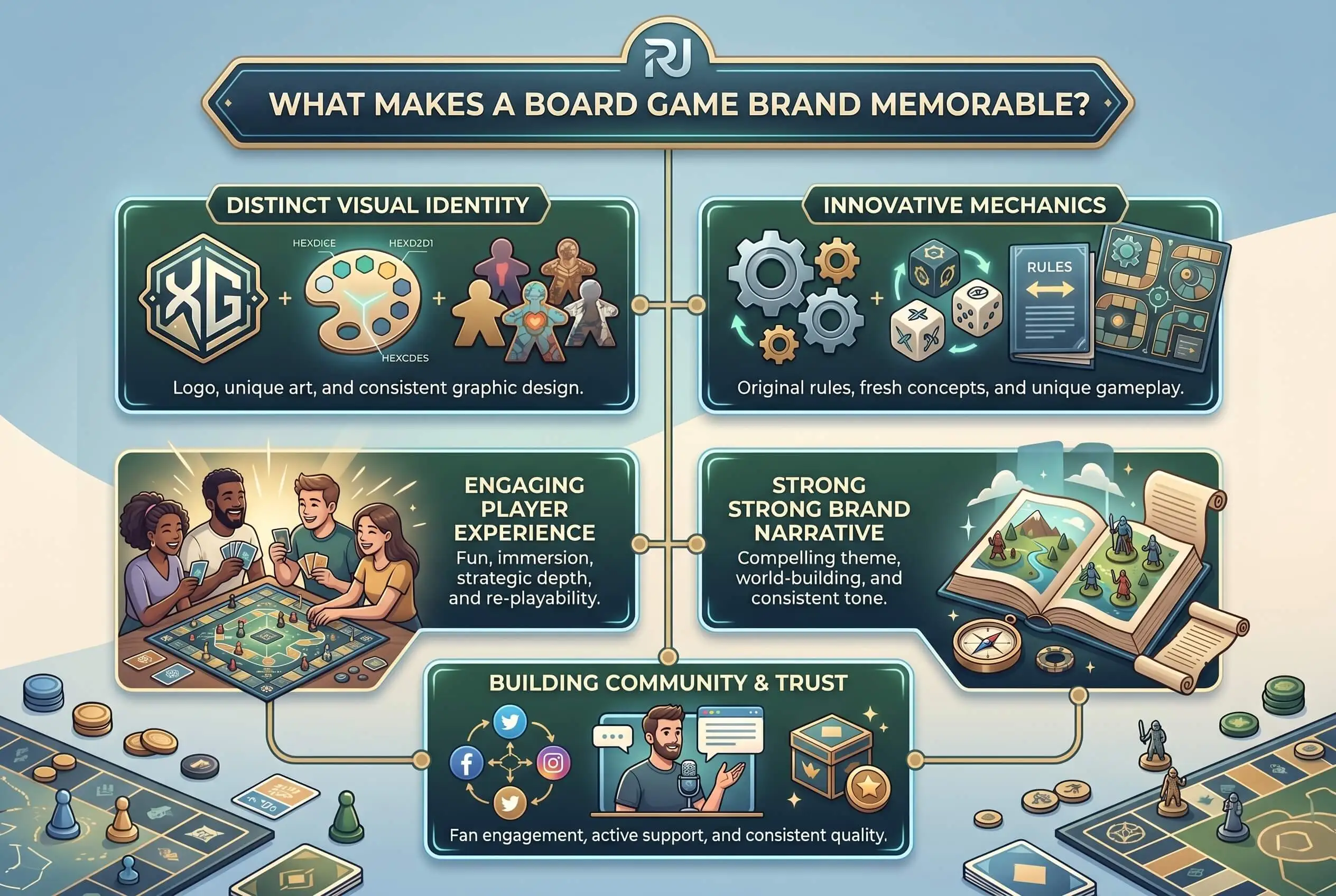
The Five Elements of a Memorable Board Game Brand
Positioning That Names a Hole in the Shelf
Positioning is the one-sentence answer to who the game is for and why it deserves a slot in their collection. The brands that get remembered have a clean, defensible answer to that question. The ones that don't, vanish.
Wingspan is the cleanest modern example. Before it launched in March 2019, the strategy category was dominated by combat, conquest, and industrial economics. Stonemaier Games dropped a beautiful, accessible, science-respectful nature game into that same audience, and the hole on the shelf turned out to be enormous.
Most indie brands stall at this step before they stall anywhere else. They describe their game in mechanics ("worker placement with deck-building") instead of in the gap it fills. Players don't browse by mechanic. They browse by feeling and by gap. If you can't name the hole your game fills in one sentence, neither can anyone else.
For a deeper framework, the guide on finding your unique value proposition with limited resources walks through the exercise.
Visual Identity That Survives a Thumbnail
Your biggest single brand asset is your silhouette on a digital storefront. It has to read at 200 pixels wide on a phone, again at 800 pixels wide on a desktop, and again from six feet away on a retail shelf.
Azul does this with tile-pattern minimalism. Catan does it with hex iconography you can spot across a crowded room. Exploding Kittens does it with absurdist line art that stays recognizable even in greyscale. Every one of these brands picked a visual language and held it across every box, every expansion, every social post.
Generic fantasy art is where most indie games get crushed in this round. A generic dragon, a generic warrior, a generic glowing sword: none of those survive the thumbnail test. Visual identity isn't about better art. It's about a coherent visual language that compresses well and stays recognizable everywhere it appears.
Voice and Founder Storytelling
Players want to know who made the game and why. Always. Your voice shows up in the rulebook intro, the Kickstarter video, the Instagram caption, the response to a two-star BoardGameGeek review. Consciously or not, all of it adds up to the brand.
Exploding Kittens leans into irreverent, self-aware humor you can hear in everything from box copy to customer service emails. Stonemaier Games goes the opposite direction. Jamey Stegmaier publishes detailed blog posts about manufacturing costs, design tenets, and the mistakes he's made, and that openness is the brand. Both voices work because both stay consistent across every channel where the brand appears.
The hard part isn't having a voice. It's translating that voice into a copy that sells at every touchpoint without sounding like a corporate brochure. For creators who'd rather spend their hours designing the game than fighting with the language around it, professional board game copywriting services exist for exactly this kind of voice translation work.
Theme and Emotional Hook
The theme works at a different level than setting. The setting is the medieval village or the space station. Theme is the feeling the game promises when players first sit down at the table.
Pandemic promises cooperative dread. Ticket to Ride promises turn-of-the-century optimism. Spirit Island promises the satisfaction of anti-colonial reclamation. Every one of those themes is a feeling first and a setting second. The memorable brands pick an emotional register and hold it everywhere the brand appears: on the box, in the rulebook, in the launch trailer, in the way the customer service team signs off emails.
The forgettable brands pick a setting (medieval, space, post-apocalypse) and stop there. Setting without emotional intent is just decoration. Players forget decoration. They remember how a game made them feel at the table the first time they played it.
If you can't name the feeling your game promises in two words, you're not done positioning yet.
Community Signal
A board game brand isn't memorable until a community claims it. Your job as a publisher is to give players signals worth repeating.
The Wingspan birdfeeder dice tower. The Catan robber. Pandemic's color-coded disease cubes. The Exploding Kittens "Nope" card. Every one of those is a piece of branded vocabulary that lives in player conversations long after the box is closed.
BoardGameGeek runs the trust layer for the entire hobby, and reviews there outweigh almost any paid placement you can buy. Reviewers, podcasters, and Twitch streamers are your brand's real amplifiers, and your only job is to make their work easy. Send the prototype early. Answer questions fast. Give them quotable language they can drop into a review without having to translate. The brand grows when other people repeat your words back to you.
For studios building this layer for the first time, the brand bible guide for tight budgets is a useful starting point.
"After four years writing copy for indie tabletop creators alongside a professional marketing agency, I've learned how little brand memorability actually depends on game quality. The deciding factor is whether your one-sentence pitch survives the four-second test at the new-release wall. Mediocre games with sharper positioning routinely beat better-designed games. Every single time."
7 Essential Resources
These industry references go deeper on board game branding, marketing, and the broader tabletop ecosystem.
BoardGameGeek. https://boardgamegeek.com — The hobby's central trust layer, with community ratings, reviews, forum discussion, and the most complete database of published games anywhere.
ICv2. https://icv2.com/articles/markets/view/games — Industry trade publication tracking hobby games sales, distribution, and retail trends.
Dicebreaker. https://www.dicebreaker.com — Board game journalism with strong coverage of indie launches, Kickstarter analysis, and design interviews.
Kickstarter Tabletop Games. https://www.kickstarter.com/discover/categories/games/tabletop-games — The largest single discovery surface for new tabletop titles, with active backer demographics and live campaign data.
Stonemaier Games blog. https://stonemaiergames.com — Jamey Stegmaier's long-running open-source notes on game publishing, manufacturing, and marketing.
Cardboard Edison. https://cardboardedison.com — Design-focused resource library covering playtesting, publisher submissions, and the craft of board game development.
Wikipedia: Board game. https://en.wikipedia.org/wiki/Board_game — The foundational reference for the category, with sourced history and a clean taxonomy of game types.
3 Statistics
The global board games market reached $15.83 billion in 2025, up from $14.37 billion the year before, according to Fortune Business Insights: https://www.fortunebusinessinsights.com/board-games-market-104972. Growth at that scale means more players entering the hobby and more shelf competition for every new title you launch.
Kickstarter raised $270 million for Games projects in 2024, with tabletop titles representing 83% of those pledges, per Kickstarter's official year-end recap: https://updates.kickstarter.com/kickstarter-biggest-platform-for-games/. Crowdfunding is now the default launch surface for indie publishers, which means your brand differentiation has to happen before a player ever pledges.
BoardGameGeek added 7,834 new board game and expansion entries in 2024, based on community-tabulated BGG data: https://boardgamegeek.com/thread/3598117. That's roughly 21 new titles entering the hobby every day. Every one of them is competing for the same finite player attention.
Final Thoughts and Opinion
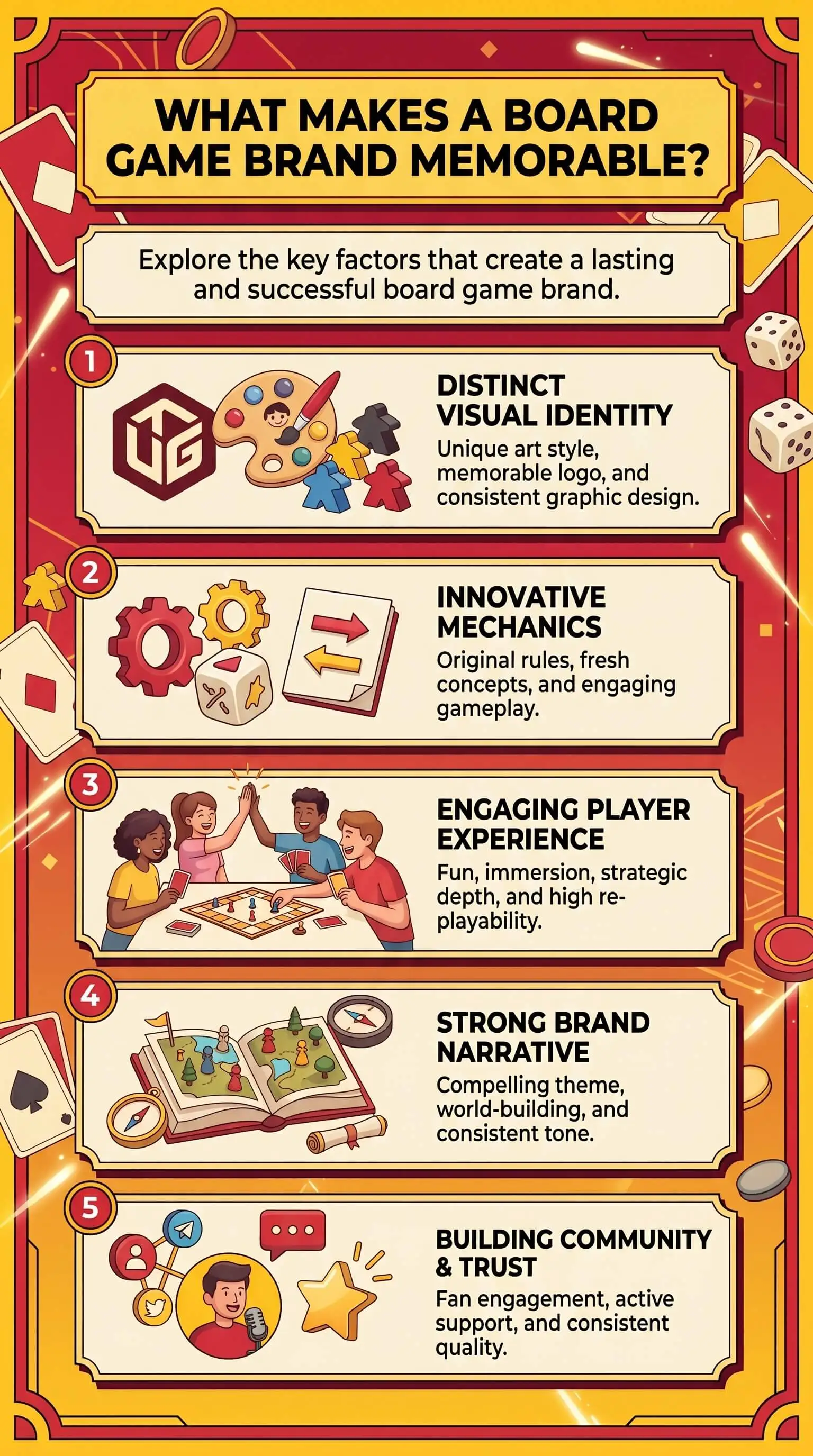
The five elements above (positioning, visual identity, voice, theme, community signal) work as a connected system, not items on a checklist. A game with strong positioning but generic visual identity won't survive the thumbnail. A game with a sharp visual identity but no founder voice feels corporate. A game with a founder voice but no community signal stays small. Memorability happens when you get all five mostly right and at least one of them is genuinely remarkable.
The good news is that none of this requires a Hasbro-sized budget. Wingspan won by out-positioning its competition, not by outspending it. Stonemaier didn't outbuy bigger publishers on Facebook ads. They out-communicated them on a blog Jamey Stegmaier has been writing for more than a decade. The indie path to a memorable brand is real, it's repeatable, and it's been repeated.
The honest catch is that doing this work alongside designing the actual game is hard. I've watched plenty of brilliant designers run completely out of energy and language by the time the brand questions show up, and that's the natural moment to bring in someone who already lives in this space, whether that's a brand strategist, a marketing partner, or a copywriter who knows the difference between a Eurogame and a thematic dungeon-crawler. The work compounds either way. The only real question is who's doing it.
Frequently Asked Questions
What makes a board game brand memorable?
A memorable board game brand combines clear positioning, a distinctive visual identity, a consistent founder voice, an emotional theme, and a community signal that players repeat. Get four of the five mostly right and at least one of them remarkable, and the brand sticks.
How do small board game publishers compete with Hasbro and Asmodee?
Small publishers don't compete on shelf space or ad budget. They compete on meaning, voice, and community connection. The big publishers can't move quickly or speak personally. Indies can, and that's the whole opening.
Do I need a copywriter to brand my board game?
Not strictly. But most designers I talk to are gassed by the time the brand questions show up. They spent all their bandwidth on the game itself. Bringing in board game copywriting services or a marketing partner who already lives in the hobby can shortcut years of trial-and-error and keep your launch from getting derailed by the wrong words at the wrong moment.
What's the difference between a board game's theme and its brand?
Theme is the feeling the game promises at the table, like cooperative dread or turn-of-the-century optimism. Brand is the consistent expression of that feeling across the box, rulebook, marketing copy, social posts, and customer interactions. Theme is the seed. Brand is the whole plant.
How long does it take to build a recognizable board game brand?
Most indie brands take two to three years to build the kind of community recognition that drives organic discovery. The work compounds, though. Year one feels invisible. Year three starts to feel inevitable.
Your Next Step
If you're building a brand around a tabletop product, here's the audit that matters most. Write down your one-sentence positioning today, then ask three players whether it matches the game they actually experienced at the table. If those two sentences don't line up, you've just found where the brand work needs to begin. The guide on branding yourself authentically walks through the next step from there.