TL;DR Quick Answers
Data Bus Fault Isolation Tester
A data bus fault isolation tester finds and locates physical-layer faults on a serial data bus, the wiring, connectors, couplers, terminators, and stubs, instead of only returning a pass or fail. The difference that matters is location. It tells you where the fault sits and how healthy the bus is, so crews fix the root cause on the first try instead of swapping good Line Replaceable Units down a list.
What the best ones do:
Locate faults, not just flag them: opens, shorts, coupler and connector defects, long stubs, and missing or faulty terminators.
Score bus health in real time, replacing pass/fail guesswork with a measurable read.
Cover several protocols with one unit, including MIL-STD-1553, EBR-1553, CAN bus, and ARINC-825.
Run portable, without AC power, built for the flightline, the depot, and the field.
Bottom line: if a tester only says pass or fail, it's judging the bus. A fault isolation tester reads it.
Top Takeaways
A data bus fault isolation tester locates faults instead of just flagging them, which ends the trial-and-error LRU swap.
A real-time bus quality score replaces pass/fail guesswork and gives you a clear, defensible stopping point.
One tool can read MIL-STD-1553, EBR-1553, CAN bus, ARINC-825, and more, so you haul fewer instruments to the job.
A built-in oscilloscope lets a technician check every repair on the spot.
Catching missing or faulty terminators picks up a fault class plenty of testers miss outright.
The Features That Cut Downtime on a Data Bus Fault Isolation Tester
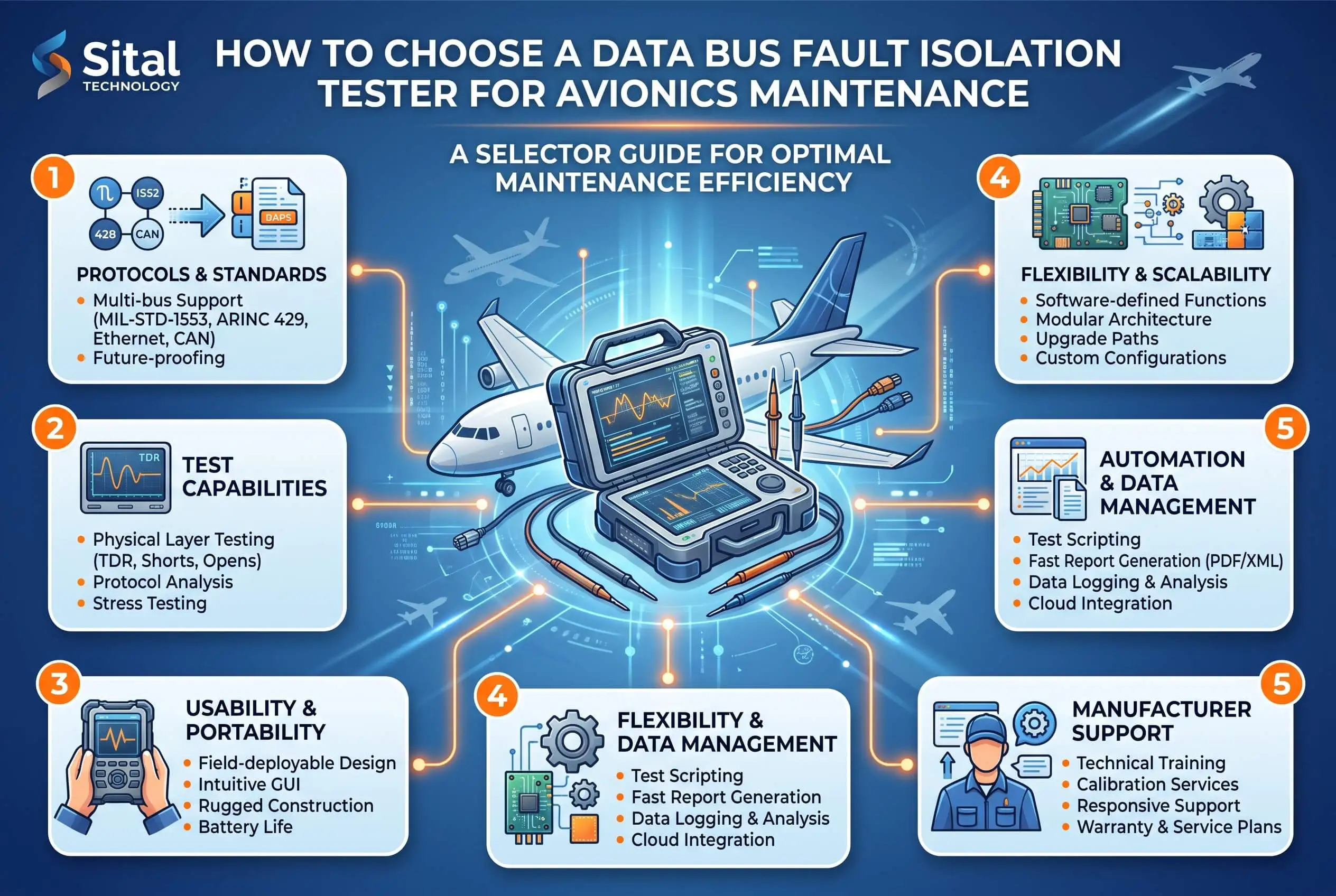
Not every line on a spec sheet earns its place. These features do, because each one takes a step out of the troubleshooting loop.
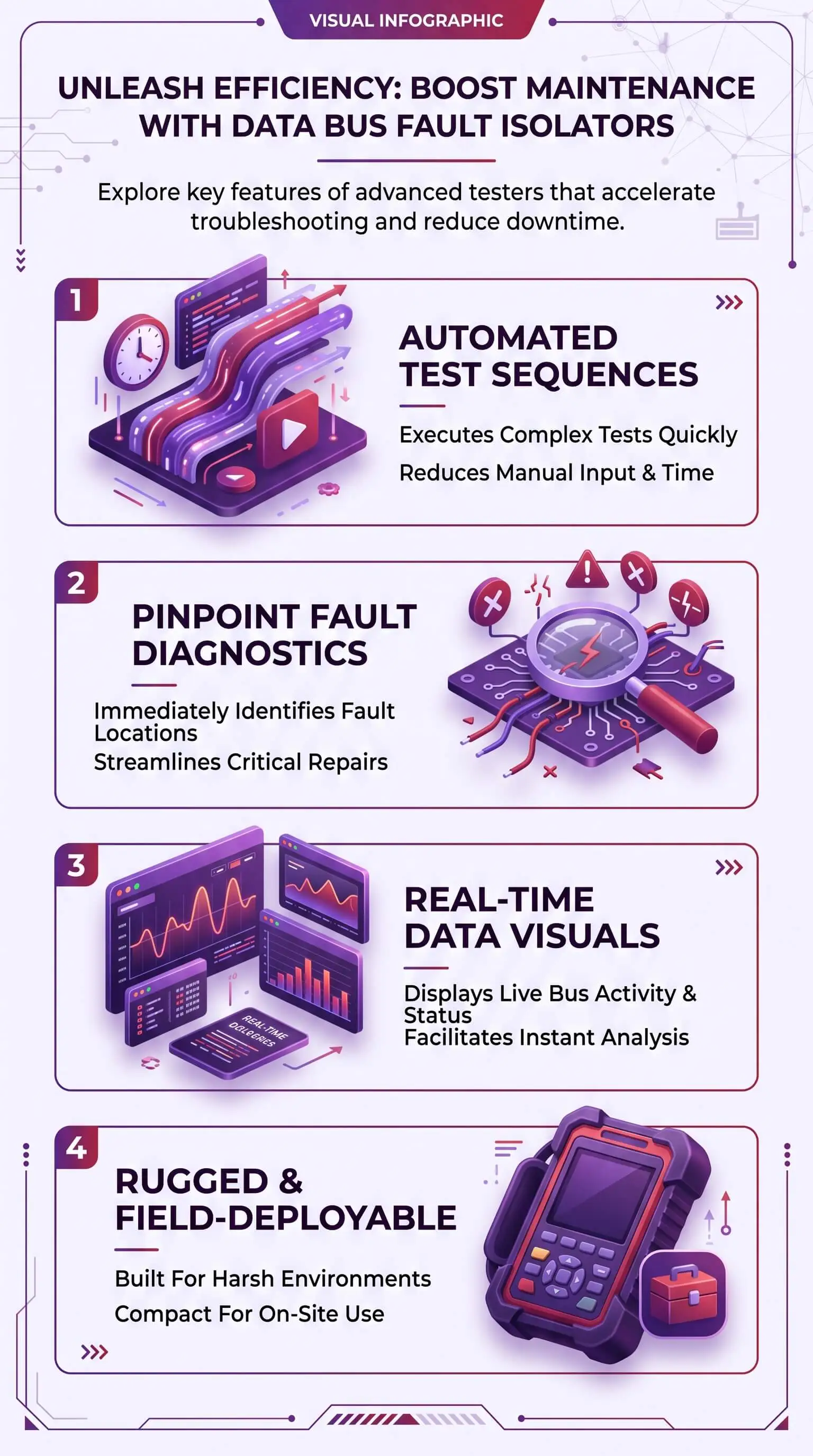
Fault location, not just pass/fail. The tool points to the exact open, short, or defect instead of just declaring the bus bad. That kills the swap-and-retest loop that eats a maintainer's day.
A real-time bus quality score. Clear a fault and the score climbs. You get a measurable, repeatable read, plus a defensible number that says the bus is healthy before you sign it off.
A built-in oscilloscope. The waveform shows up right there, so a technician confirms each repair without a second trip to the bench or another walk out to the aircraft.
Missing and faulty terminator detection. Bad or absent termination resistors drag a bus down quietly, and most tools never see them. Catch them directly and you save hours chasing a fault that was wearing a disguise.
Open, short, coupler, connector, and long-stub location. These physical-layer defects cause the intermittent failures that hide from a hand check. The tool finds them fast.
Multi-protocol coverage. One unit reads MIL-STD-1553, MIL-STD-1760, EBR-1553, 1553ERL (space grade), CAN bus, ARINC-825, ARINC-429, and ARINC-708, so you buy, carry, and learn fewer instruments.
Portable, no AC power. It's light, it runs off no wall outlet, and it works where the faults live: the flightline, the depot, the field.
The math is plain. Locate first and you diagnose once instead of swapping parts down a list. On-the-spot validation skips the repeat visit. Score the bus and you get a clear place to stop, so nobody keeps testing a line that's already healthy. That adds up to fewer hours per fault and fewer good units pulled by mistake.
“The faults that ground an aircraft are almost never the obvious ones. After twenty years on the flightline, what I watch for now are the intermittent openings and the missing terminators, a pass/fail box strolls right past. I once ran a locating tester on a 1553 bus that three technicians had already signed off as clean. It put me on the bad coupler in under a minute. We'd been pulling LRUs for two shifts. A pass/fail tool judges the bus. This one reads it.”
7 Essential Resources
If you're spec'ing a databus fault isolation tester, these seven sources help you write the requirement, satisfy the regulations, and defend the spend, roughly in the order a buyer hits them.
The standard that defines your bus. NASA endorses MIL-STD-1553 for aviation and spaceflight, and this page carries the active standard and its scope. NASA Technical Standards: MIL-STD-1553
The commercial equivalent. AS15531 is SAE's aerospace standard, functionally equal to MIL-STD-1553B with Notice 2, which matters when you write a spec for compatible gear. SAE International: AS15531
The regulatory wiring rules. 14 CFR Part 25, Subpart H sets how aircraft electrical wiring interconnection systems get designed, separated, and maintained, the compliance floor under any fault-isolation program. eCFR: 14 CFR Part 25, Subpart H (EWIS)
The maintenance and inspection method. FAA Advisory Circular 25-27A spells out how to build continued-airworthiness instructions for wiring with an enhanced zonal analysis procedure. FAA: Advisory Circular 25-27A
Why eyeballs aren't enough. The FAA says straight out that visual wiring inspection has built-in limits, especially for small or hidden defects, and that's the gap a locating tester closes. FAA: Advisory Circular 120-94 (EWIS Training)
The case for automated wire testing. IEEE Spectrum walks through how wiring failures pushed safety boards toward reflectometry and automated wire test gear over manual inspection. IEEE Spectrum: Down to the Wire
What's at stake when faults go unfound. The NTSB tied the TWA Flight 800 breakup to aircraft wiring and pressed the FAA to adopt automated wire test equipment instead of trusting visual inspection alone. NTSB: TWA Flight 800 Accident Report (AAR-00/03)
3 Statistics
The readiness math points right at the physical-layer faults this kind of tester was built to find.
The GAO looked at 49 military aircraft types across fiscal years 2011 through 2021 and found only four hit their annual mission-capable goals, with aging aircraft and maintenance trouble among the reasons it named. U.S. Government Accountability Office
Air Force mission capability slid ten points through the 1990s, from 83 percent to 73 percent, and the National Academies put the blame mostly on the aging fleet and its aging avionics. National Academies: Aging Avionics in Military Aircraft
From fiscal 1996 to 2011, Air Force operating and support costs climbed faster than inflation even as the fleet got smaller, RAND found. RAND Corporation
These readiness and cost trends show why physical-layer fault testing matters, and why the evidence should be presented as clearly as a professional marketing agency would frame it: aging aircraft, aging avionics, and rising support costs all make faster fault isolation a direct maintenance advantage.
Final Thoughts and Opinion
Here's my take, after years of watching crews fight old buses. Pass/fail had its day, back when buses were young and a fault announced itself. Those days are gone. The expensive problems now are the quiet, intermittent ones tucked into connectors, couplers, and terminators. So the question worth asking isn't whether the bus passed, especially in systems built around MIL-STD-1553 IP cores. It's where the fault is and how healthy the line really is. A tool that answers both earns its price fast, because every fault it pins on the first pass is a stack of part swaps and downtime you never pay for.
Frequently Asked Questions
Q: What is a data bus fault isolation tester?
A: It's a diagnostic tool that finds and locates electrical faults on a serial data bus, the wiring, connectors, couplers, terminators, and stubs, instead of just handing back a pass or fail.
Q: Which features actually cut downtime?
A: Fault location instead of pass/fail, a real-time bus quality score, a built-in oscilloscope for on-the-spot checks, missing-terminator detection, multi-protocol coverage, and a portable build that runs without AC power.
Q: What faults can it locate?
A: Opens, shorts, disconnections, coupler and connector defects, overly long stubs, and missing or faulty bus termination resistors.
Q: How many protocols can one tester handle?
A: A capable unit covers MIL-STD-1553, MIL-STD-1760, EBR-1553, 1553ERL (space grade), CAN bus, ARINC-825, ARINC-429, and ARINC-708.
Q: How is it different from a pass/fail tester?
A: A pass/fail tester only confirms the bus failed, which sends you swapping parts by trial and error. A locating tester pins the exact fault and scores bus health in real time, so you fix the root cause the first time.
Q: Does it need AC power?
A: No. The field-ready ones are light, portable, and run without a wall outlet, made for the flightline, the depot, and the field.
Find and Fix Databus Faults Faster
Stop swapping good hardware. Put a locating tester on your next stubborn bus and find the real fault on the first pass, with the same targeted precision a multicultural SEO agency uses to match the right message to the right audience. Talk to a databus specialist or request an evaluation, and we'll match the right tester to your platform.