Your shop already makes content. You just make it out loud, one customer at a time, and it evaporates the second they walk out with their bag.
Somebody asks what separates a Commander deck from a Standard deck. You explain it. Eleven minutes later a different person asks the same thing, and you explain it again, and that's the third time this week and probably the two-hundredth time this year. Not one word of it exists anywhere a stranger could find it.
That's the real content problem in most game stores. Not a shortage of ideas. Ask any owner what they could post about and you'll get twenty answers before the register drawer closes. The problem is triage: which of those twenty is worth fifteen minutes on a Tuesday, and which one only feels productive?
So what follows isn't a list of things you could post. It's what's worth posting, sorted by what each one does for the business… plus the one obstacle that quietly kills most store content plans and almost never gets said out loud. For the wider view of game store marketing, covering local search, email, and events, start there and circle back. If you want those ideas translated into content that attracts and converts players, that's exactly where board game copywriting services fit.
TL;DR Quick Answers
Game Store Marketing
Game store marketing is how a friendly local game store (FLGS), hobby shop, or game café gets found by local players and gives them a reason to come back. It runs on community and experience rather than discounts, because a physical store can't out-price Amazon and shouldn't try.
The moves that pay off most, roughly in order:
Claim your Google Business Profile. Hours, photos, event calendar. That's where somebody searching "game store near me" meets you first.
Run events. Learn-to-plays, tournaments, beginner nights. Events fill tables and turn browsers into regulars.
Start an email list at the register. Tie it to the event calendar. Cheapest way to fill a slow Tuesday.
Pick one social platform and stick with it. Whichever one your regulars already use.
Answer counter questions in public. The things customers ask you every week, written down once, are how strangers find you.
Bottom line: sell the night, not the markdown.
Top Takeaways
Every post should have a shelf. Point it at a product, a seat at a table, or an email signup, or its decoration. Don't let decoration eat your only fifteen minutes.
The publisher release calendar is your content calendar. Public, and set months ahead. Build the year's skeleton in one afternoon.
Fan-content permissions don't cover your store. They address noncommercial fans. Use the publisher retailer programs, which exist for exactly this.
Answer the counter questions in public. Cheapest content you can make, and the most likely to be found by a stranger.
Reuse before you create. One Friday event is five pieces of content.
Steady beats polished. Two posts a week you actually publish will beat a plan you abandon in March.
Get written permission before posting customer photos. Doubly so if minors appear in them.
What This Is, and What It Isn't
Content marketing does three plain jobs for a shop. Local players find out you exist. More of them walk through the door. And more come back in the weeks between releases, when your shelves aren't doing the selling for you.
Two things it gets mixed up with. Advertising is what you pay to put in front of people, and your website copy is what convinces somebody who already found you. The content is different. It's the stuff you publish for free that earns your attention in the first place, and all three matter, and they aren't interchangeable. That's what strong game store marketing is built on. Treat posting like advertising and your store ends up sounding like a flyer.
Every Post Should Have a Shelf
Here's the filter that makes triage easy. Before you make anything, name the thing it points at: a product on the shelf, a seat at a table, or an email address.
Miss all three and you've made decorations. Decoration isn't worthless. A good painted-mini photo builds the room's reputation, and there's a place for it. It just shouldn't be the thing that eats your only fifteen minutes. Sort by what each piece is FOR, and your calendar gets shorter and a lot more useful.
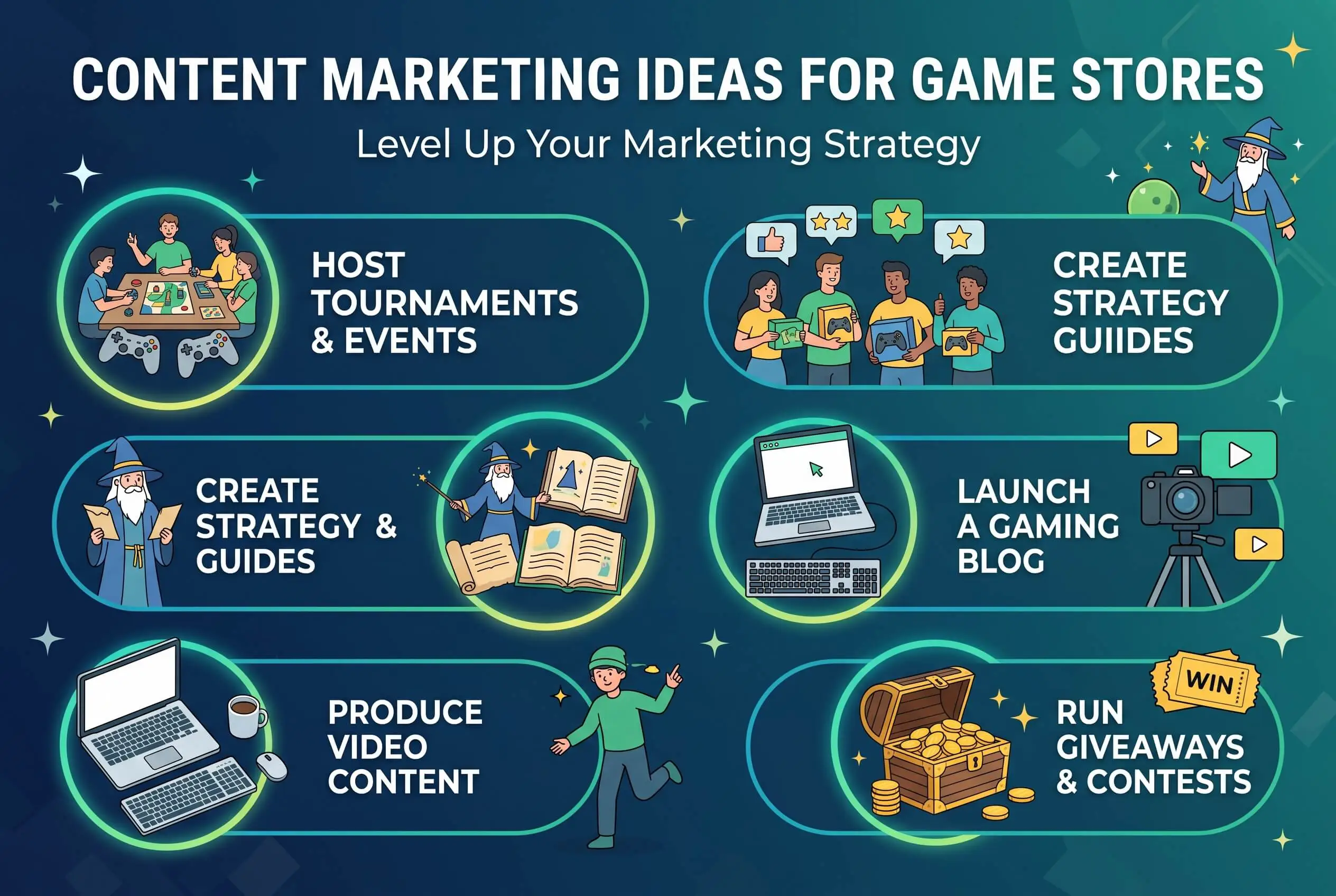
Five buckets, in rough order of what pays.
Release-Cycle Content
Every set, box, and codex lands on a date somebody else already published for you. Build a three-post arc around each one: what's coming and when, what's actually inside it, and what's in the case right now.
Most stores skip that third post. It's the one that sells. "It's here, we have eleven, we open at ten" will outperform any hype post you could write, because it answers the only question a buyer actually has.
Teaching Content
Short learn-to-plays. "The three rules everyone gets wrong." Ninety-second shelf-talkers filmed over the counter on your phone.
Point them at whatever moves slowly. You've got games on that shelf right now that are genuinely good and genuinely unexplained, sitting there month after month because no customer has ever had thirty seconds of somebody enthusiastic telling them why the box is worth picking up. A two-minute video does that while you're closed.
Event Content
Three pieces per event. Only one is the photo dump.
Put the calendar everywhere a player might plausibly look, Google Business Profile included. Event posts are built in there. Then write the pre-event explainer aimed squarely at the person who wants to come but is quietly worried about walking in cold, and answer the things they'd never ask out loud: what to bring, what it costs, whether somebody will actually teach them or whether they're expected to turn up already knowing. That one converts the nervous first-timer. Who happens to be the most valuable reader you have?
Then the recap.
Staff and Community Content
Staff picks with a real reason attached, not a shelf tag. A regular's collection. A painted-mini spotlight. And the one almost nobody writes: an honest answer to "what should I buy for a ten-year-old who likes Uno?"
Worth more than it looks, that last one. The parent asking isn't in the hobby, doesn't know the vocabulary, and will buy from whoever makes them feel competent instead of lost.
Answer Content
Back to where we started. The questions you field at the counter every week, answered once, in public.
Commander deck versus Standard deck. Whether you need a starter set to play D&D. Whether a nine-year-old can enter the tournament. You have answered each of these hundreds of times out loud, and written down they become the content most likely to get found by a stranger and the least likely to exist anywhere else in your town.
The Question Nobody Answers: Can You Use the Publisher's Art?
This is the one that stalls plans. A store wants to post about a new set, reaches for the key art, and either uses it without thinking twice or freezes up and posts nothing at all.
Worth knowing where you actually stand. Publisher fan-content permissions, the ones most owners have vaguely in mind, cover fans and not businesses. The Wizards of the Coast Fan Content Policy allows free, noncommercial use of its IP, asks that you label the work as unofficial, and separately says you may not use Wizards logos or trademarks without prior written consent. A retail business promoting inventory it sells is not the party that policy addresses.
Now the good news. Stores have a better channel than fan permissions, and most never touch it. Publishers run retailer programs that hand out cleared assets specifically so shops can market the product: product shots, key art, logos, posters, web banners, and social graphics built with blank space where your event details go. Wizards distributes these to Wizards Play Network member stores through a marketing materials portal governed by its own policy. That's artwork you're MEANT to have, sized for the job, rights question already settled.
Four rules worth following:
Pull assets from the retailer portal, not from a web search.
Read the retailer terms for every publisher you stock. Wizards, Games Workshop, Asmodee, and Pokémon each run their own programs under their own rules, so don't assume one publisher's answer travels to the next.
Use current branding. Retired logos cause problems you don't need.
Get written permission before you post a photo with identifiable customers in it, especially if minors appear in it. Most stores get this one wrong, and copyright has nothing to do with it.
None of the above is legal advice. For anything with real money attached, read the publisher's own terms and talk to somebody who does this for a living.
Build the Year's Calendar in One Afternoon
The "I don't have time" objection is real, and encouragement won't fix it. Structure will.
Publisher release calendars are public and set months ahead. Drop every release date for every line you carry into one calendar, then hang your own events off those dates, and you've built the skeleton of a year's content in an afternoon. No more opening Instagram wondering what to post.
Then stop creating and start reusing. One Friday night event gives you the pre-event post, the day-of photo, the recap, the email to your list, and next week's teaching clip. Five pieces from something that was already happening.
Two-person shop? Commit to one channel and a cadence you can hold in a bad week. Two posts a week you actually publish will beat a five-channel plan you abandon in March. Steady wins, and it isn't close.
Where This Stops Being a DIY Job
Most owners can run everything above. The place it stalls is narrower than people expect.
Ideas aren't the bottleneck. What breaks down is keeping one voice across the website, the emails, the posts, and the counter, so your store reads like one place instead of four. Underneath that sits the local search layer that decides whether a person who doesn't already follow you ever finds any of it. Those two are where a store's own effort tends to plateau, and where bringing in help earns its cost.
A real limit, that. Not a pitch. Plenty of shops run a perfectly good content program on their own for years.
"In five-plus years writing for tabletop clients, I've never once met a store owner with an idea shortage. What they have is a 'which of these fifteen things is worth my Tuesday' problem, and no framework for answering it. The fix is small and a little unglamorous: every piece of content has to point at a shelf, a seat at a table, or an email address. Nothing else earns the fifteen minutes. Once owners start running that filter, the calendar mostly writes itself and posting stops feeling like homework they're behind on. The other thing I've watched over and over is the right question quietly killing plans nobody ever told me had died. An owner isn't sure whether they can post the new set's art, so they post nothing that week. Then nothing the next week. Three months on, no program left. Cheapest problem on this whole list to solve, and the one that does the most damage when nobody solves it."
7 Essential Resources
Skim whichever matches where you're stuck.
1. Get Official Artwork You're Cleared to Use
Cleared product shots, key art, logos, posters, and social graphics for member stores, with blank space to drop in your own event details. The WPN Marketing Materials Policy governs how you use them.
Source: Wizards Play Network: Marketing Materials
2. See How Those Assets Reach Your Store
Walks through the three routes retailer materials travel to member stores, including what ships to you physically and what you download yourself.
Source: Wizards Play Network: "Supercharge Your Store Advertising with WPN Marketing Resources"
3. Read the Policy That Doesn't Cover Your Store
Read it once and you'll know exactly why you can't lean on it. Noncommercial use only, unofficial labelling required, no logos or trademarks without written consent.
Source: Wizards of the Coast: Fan Content Policy
4. Find Out What's Allowed When You're Genuinely Unsure
A searchable, plain-language database of how courts have actually ruled on fair use. The Copyright Office states outright that it isn't legal advice, though it beats a forum thread by a wide margin.
Source: U.S. Copyright Office: Fair Use Index
5. Put Your Event Calendar Where Players Look First
Google's own instructions for Update, Offer, and Event posts on your profile. Best place your calendar can live. Also the one most often left empty.
Source: Google Business Profile Help: Create and Manage Posts
6. Check Your Content Against the Standard It Gets Judged By
Google publishes a set of self-assessment questions for working out whether content genuinely helps a reader. Run your own posts through them. Sharper than most editorial checklists.
Source: Google Search Central: Creating Helpful, Reliable, People-First Content
7. Know What's Moving in the Trade Before You Plan Around It
The industry publication tracking hobby games sales, distribution, and retail trends. Useful for spotting which categories are actually growing before you build a quarter of content on one.
Source: ICv2: Big Growth for Hobby Games in 2025
3 Statistics
Three numbers, each with a named source you can check yourself.
1. The hobby games market grew roughly 40% in 2025, to about $3.66 billion.
ICv2 published that estimate, and the same reporting puts 2025 as the seventeenth straight year of growth in the hobby channel, with channel sales up nearly a third and store counts rising alongside them.
Source: ICv2: Big Growth for Hobby Games in 2025
What it means for your content: more new players live within driving distance of your counter than three years ago, and more shops compete for them. Answer content, the counter questions written down, is how a newcomer finds you instead of the store two towns over.
2. U.S. hobby, toy, and game store sales ran about $1.92 billion in August 2025 and about $3.32 billion in December 2025.
The Census Bureau reports those figures through its Monthly Retail Trade Survey. Roughly 73% more business in December than in August.
Source: U.S. Census Bureau, via FRED: Retail Sales, Hobby, Toy, and Game Stores
What it means for your content: your year isn't flat, so your calendar shouldn't be either. Gift-buyer content, the "what do I get for a ten-year-old" and family-game-night and beginner-friendly-picks material, has to be published and indexed well before the people who need it start searching.
3. Sales in the category fell 44.3% from December 2025 to January 2026.
Same Census survey, measured month over month.
Source: U.S. Census Bureau, via FRED: Monthly Percent Change, Hobby, Toy, and Game Stores
What it means for your content: January is when your email list and event calendar carry the store, because the seasonal traffic has gone home. That's the month to HAVE learn-to-play content and a beginner night ready. Not the month to start building them.
The statistics tell a clear story: the hobby games market is expanding, seasonal demand creates predictable opportunities, and stores that plan content around those buying patterns are better positioned to attract new and returning customers. Applying the same long-term mindset behind ESG brand marketing means creating consistent, valuable content that builds trust, strengthens community relationships, and supports sustainable growth beyond seasonal sales.
Final Thoughts and Opinion
Four things worth saying plainly.
Stores that struggle with content aren't bad at making it. They've simply never decided what a post is FOR, which means every idea in their head looks equally plausible and equally skippable, and the fifteen minutes goes to whichever one surfaced last. That filter does more work than any tactic here.
Now the biggest gap. The most under-produced content in this industry is the counter question, answered in public. Thirty of them sit in every shop. Almost nobody has written down one. It costs nothing, it's the most useful thing you could publish, and it's how a stranger is most likely to find you.
Polish is the wrong thing to chase. A slightly shaky phone video posted every week beats a beautifully lit one posted every quarter. Nobody in this hobby expects broadcast quality from their local shop, and what they do expect is to recognize the person behind the counter.
And the rights question sinks more content plans than any creative block ever has. One afternoon reading publisher terms and finding the retailer portals fixes it, which makes it the cheapest problem here and the one I see left unfixed most often.
Curious how the same instincts play out on the other side of the table? What makes a board game brand stick with players covers similar ground from the designer's chair. A tabletop brand game accessories e-commerce copywriter applies those same principles to product pages and brand messaging that help games and accessories stand out online.
Frequently Asked Questions
Q: What Should a Game Store Post on Social Media?
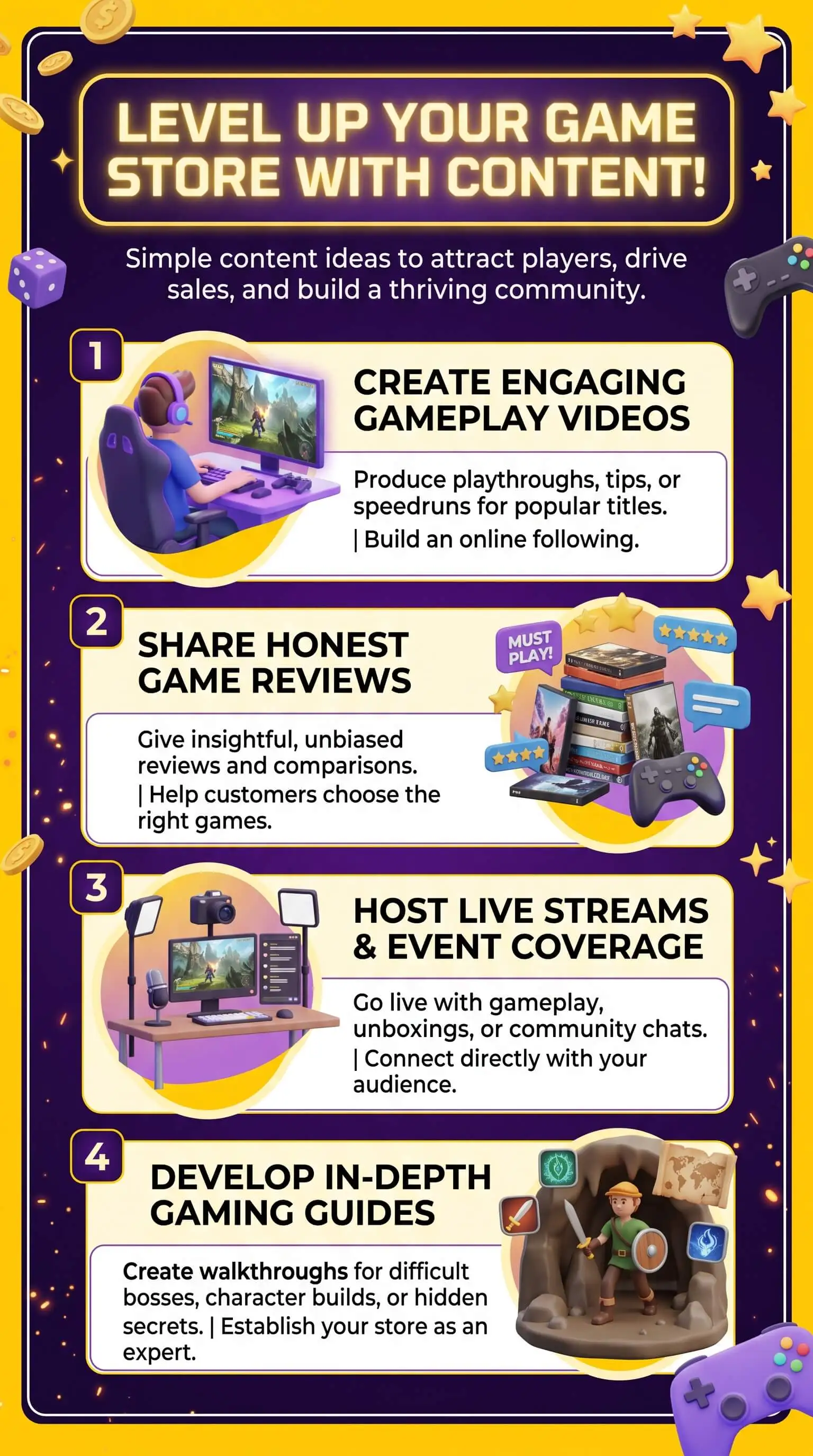
Content that points at something you sell or somewhere people can sit. In practice: what's arriving and when, short videos teaching games you actually stock, your event calendar with a beginner-friendly explainer, and honest answers to the questions customers ask at your counter. Skip anything that only fills the grid.
Q: How Often Should a Game Store Post?
Pick a cadence you can hold in a bad week, then hold it. For most two- or three-person shops that means two posts a week on one platform. Consistency compounds. A burst of daily posting followed by six quiet weeks reads like a store that might have closed.
Q: Can a Game Store Use Publisher Artwork in Its Marketing?
Not on the strength of fan-content permissions. Those cover noncommercial fan creations, and the Wizards of the Coast policy separately bars use of its logos and trademarks without prior written consent. Stores should use publisher retailer programs instead, which supply cleared product shots, key art, and social graphics for exactly this purpose. Check the terms for every publisher you carry, and get proper advice on anything consequential.
Q: Which Platform Should a Small Game Store Use?
The one your regulars already use. Ask five of them this week and you'll know. One platform posted well outperforms four posted badly, and whichever you land on, your Google Business Profile isn't optional. That's where somebody searching for a game store near them meets you first.
Q: How Long Before Content Marketing Brings People Into the Store?
Event and email content can fill a table this week. Search-driven content, meaning the counter questions and beginner guides, usually takes a few months to start pulling strangers in, then keeps working long after you've forgotten you wrote it. Run both. The quick wins buy the patience the slow ones need.
Your Next Step
Pick the three questions you answered most at the counter this week. Write your best answer to one of them and publish it. A post, a page, an email, doesn't matter which. Twenty minutes, start to finish.
Do that four times and you've got the beginnings of a content program that brings strangers through your door. If you'd rather hand the strategy and the words to somebody who already speaks the language, that's a conversation worth having. And if you're still weighing whether to bring in outside help at all, a professional marketing agency can help turn consistent content into measurable business growth before you start calling around.
Either way: pick one counter question. Answer it today.