Your firm just had its best revenue year, and the partners still took smaller draws in December. That gap is usually where the search for a different kind of accountant begins.
Look for one who treats your team's time as inventory. That means someone who tracks utilization and unbilled work, shows you margin by client and project, and can grow with you from clean books into forward-looking advice.
Accounting for professional services firms exists to answer the questions general bookkeeping can't, like why a busy quarter feels thin or when you can actually afford the next hire. You shouldn't have to guess where the margin slips.
TL;DR Quick Answers
Accounting for Professional Services Firms
Accounting for professional services firms treats your team's time as the inventory. It connects billable hours, retainers, and project costs to the books, so partners can see where margin slips and plan around feast-or-famine cash flow.
What it tracks that standard bookkeeping misses:
Utilization: billable hours as a share of available hours.
Realization: what you collect against the value of the time worked.
Work in progress (WIP): time spent but not yet invoiced, caught before it ages into write-offs.
Margin by client and project: which engagements carry the firm and which ones drain it.
Partner economics: draws, profit pools, and K-1 distributions tied to cash on hand.
Who needs it: consulting, legal, architecture, engineering, and marketing firms that sell expertise by the hour or the project.
How it scales: bookkeeping first, then outsourced accounting for closes and reporting, then fractional CFO support for forecasting and hiring decisions.
Top Takeaways
Hire for fluency in utilization, realization, and WIP.
Ask to see margin by client and project before you sign anything.
Keep partner draws tied to the cash the firm actually has.
Choose someone who already works with your time-tracking and billing tools and can grow into fractional CFO support.
Pay attention to the questions a candidate asks in the first meeting.
Why Accounting for Professional Services Firms Works Differently
A manufacturer counts boxes on a shelf. Your firm counts hours on a timesheet, and you bill, write down, or lose every one of them somewhere between the work and the invoice.
Bookkeeping keeps the record straight. Invoices go out, bills get paid, accounts reconcile. You need all of that. What it won't show you is the client who pays on time while absorbing 30 unbilled hours a month, or the flagship project that lost money once senior staff time hit the ledger.
A few things make services firms harder to read than most businesses:
Retainers, fixed fees, and milestone billing make cash flow feast-or-famine, because the money rarely lines up with the work behind it.
Work in progress (WIP), meaning time spent but not yet invoiced, ages into write-offs when nobody is watching it.
Utilization and realization move profit more than any line on the expense report.
Partner draws pull cash out on a schedule that doesn't care how the quarter went.
That's why most growing firms move to accrual-basis books, which match revenue and costs to the period when the work happened.
What to Look for in an Accountant for Your Firm
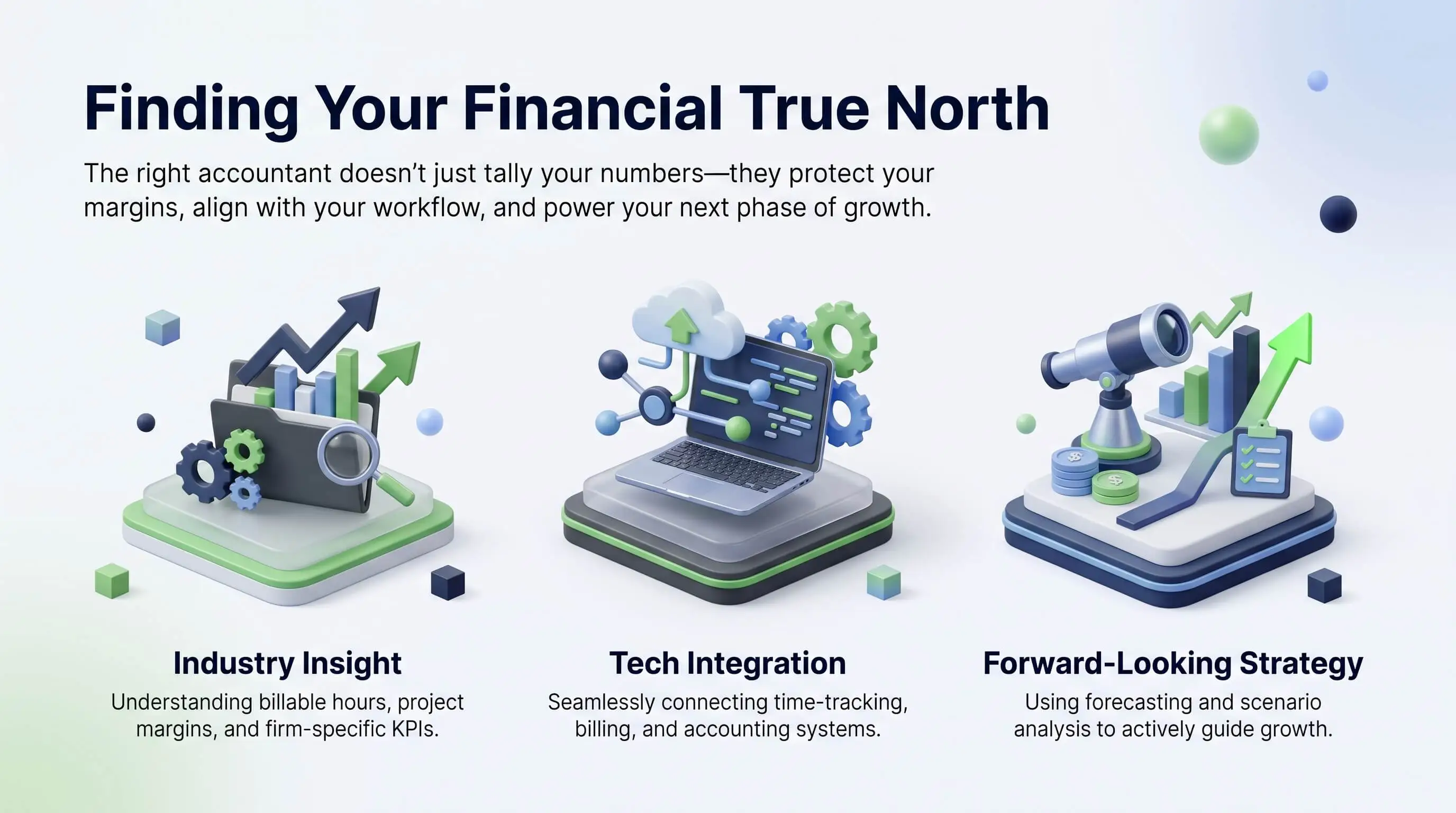
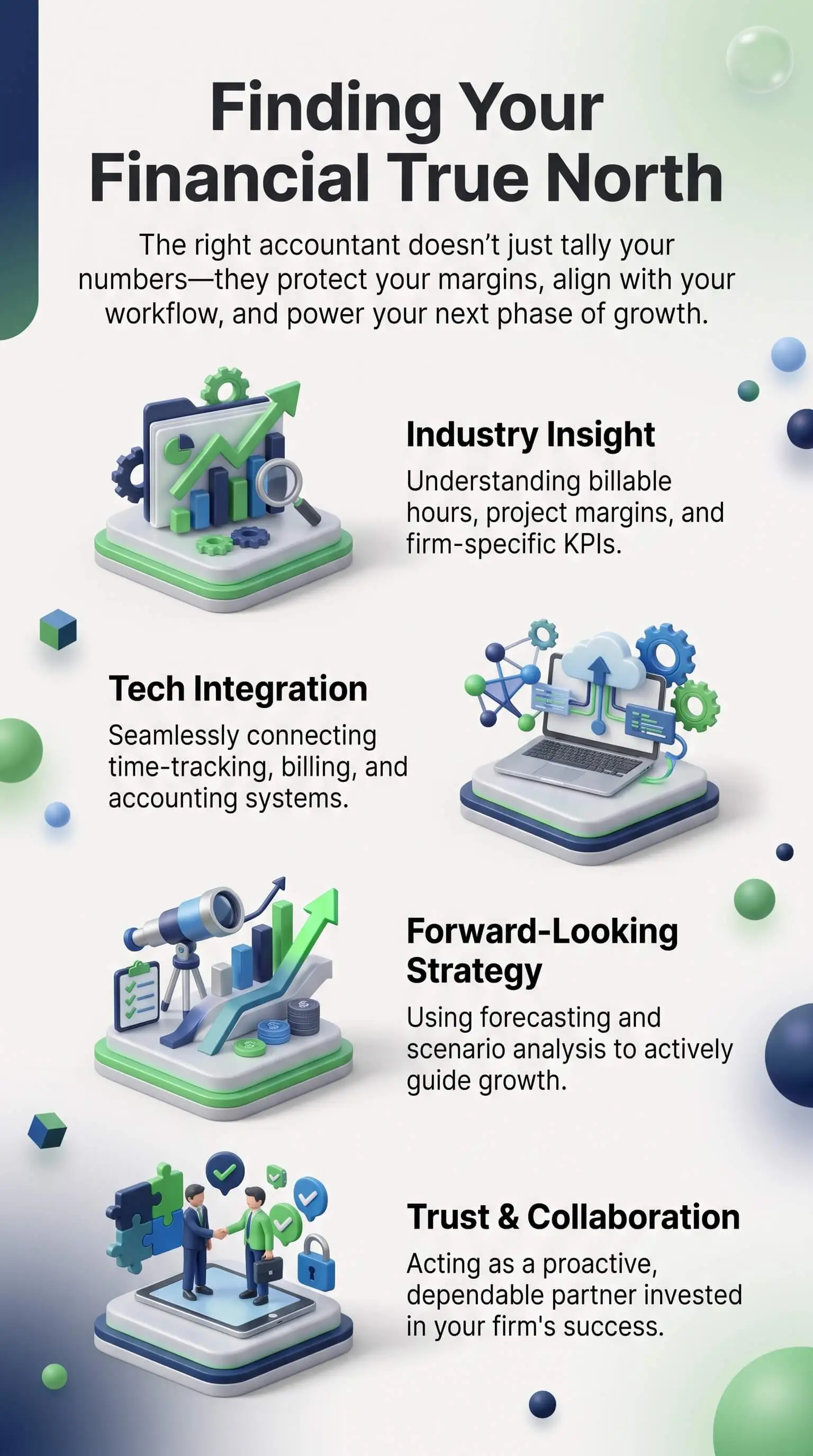
Hire the accountant who connects your time data to your finances. Specialized accounting for professional services firms picks up where clean books stop and shows how your firm makes its money. In practice, that comes down to seven things.
Fluency in Utilization and Realization
Utilization is billable hours divided by available hours. Realization is what you collect against the value of the time worked. A good accountant reports both every month and tells you what it means when they drift apart. High utilization paired with weak realization usually points to scope creep or work priced too low.
WIP Tracking and Revenue Recognition
Ask how they handle retainers, fixed-fee engagements, and projects that run past a quarter. You want to hear about WIP aging, deferred revenue, and when they recognize revenue. A vague answer here means more surprises at quarter end.
Profitability by Client, Project, and Practice Area
Job costing should show which clients carry the firm and which ones drain it. Without margin by client, pricing runs on instinct and on whoever complained last.
Experience With Partner Compensation
Once a firm has more than one owner, draws, profit pools, and K-1 distributions get complicated fast. Look for someone who keeps distributions accurate, visible to every partner, and tied to cash the firm actually has.
Fit With Your Tools
Time tracking, billing, payroll, and the general ledger should talk to each other. An accountant who already works in QuickBooks, Harvest, Gusto, or BILL can cut manual entry and shorten the stretch between finishing work and getting paid for it.
Room to Grow With You
Today you might only need dependable bookkeeping. Two years from now you'll want forecasting and capacity planning before your next hire. A partner who covers bookkeeping, outsourced accounting, and fractional CFO work saves you from switching providers every time the firm outgrows one.
Credentials, Controls, and a Steady Close
Check licenses where they apply, ask how they handle internal controls, and get the month-end calendar in writing. Firms that hold client funds, law practices especially, also need trust accounting handled to the letter.
Bookkeeper, Outsourced Accountant, CPA, or Fractional CFO?
Each role answers a different question, and most firms end up needing two or three of them as they grow.
Bookkeeper: Enters transactions, reconciles accounts, sends invoices, and pays bills. Bring one in when you need accurate records and on-time billing.
Outsourced accountant: Runs the monthly close, reporting, payroll support, receivables, budgets, and profitability views. Think of it as a full accounting department without the hiring.
CPA: Prepares and plans taxes and handles audits and attestation. You'll need one for filings, tax strategy, or audited statements.
Fractional CFO: Builds forecasts, cash flow models, KPI tracking, and hiring plans. Bring one in when partners are making big calls without forward-looking numbers.
Questions to Ask Before You Hire
How many professional services firms do you work with now, and in which fields?
Which KPIs will you report each month, and who walks us through them?
How do you track WIP and recognize revenue on retainers and fixed fees?
Can you show us profitability by client, project, and practice area?
How do you handle partner draws and distributions?
Which time-tracking, billing, and payroll tools do you already work with?
What does your month-end close look like, and when do reports land?
What changes when we're ready for CFO-level support?
Red Flags That Signal a Poor Fit
They have no current clients in professional services.
They only keep cash-basis books and have no plan for accrual as you grow.
Monthly reporting stops at a profit and loss statement.
They've never connected time-tracking data to the general ledger.
The close regularly slips into the following month.
"When we take on a new professional services client, the books are usually fine. The reconciliations tie out. What's missing is the story behind the numbers. More often than not, the margin problem turns out to be one or two retainers that grew in scope while the fee stayed put. You won't spot that on a profit and loss statement. We find it by lining up timesheets against invoices, client by client. Partners are almost always surprised, and then a little relieved, because now they know exactly what to fix."
Essential Resources
These seven are worth bookmarking before you sign with anyone. Each one comes straight from the agency or professional body that writes the rule.
Verify a CPA's License in Minutes
State boards of accountancy feed their licensing data into a single national lookup. It also flags enforcement and disciplinary actions, so you can check a candidate before the first call.
Source: NASBA CPAverify
Understand Cash Versus Accrual
The IRS explains how each method decides when income and expenses hit the books. Read it before an accountant recommends a switch, so you know what changes and why.
Source: IRS Publication 538, Accounting Periods and Methods
Know How Partner Distributions Are Taxed
For partnerships and multi-member LLCs, this is the reference on distributions, guaranteed payments, and partner basis. Every K-1 your partners receive rests on it.
Source: IRS Publication 541, Partnerships
Classify Contractors Correctly
Plenty of services firms lean on freelancers and subcontractors. The IRS lays out its behavioral, financial, and relationship tests, along with what misclassification can cost.
Source: IRS, Independent Contractor or Employee?
Get Payroll Tax Duties Right
The employer's tax guide covers withholding, deposits, and reporting for everyone on payroll. Your accountant should know it is cold. You should at least know where it lives.
Source: IRS Publication 15, Employer's Tax Guide
Hold Client Funds the Right Way
Law firms and other practices that take money in advance face strict rules on keeping it separate and documented. The ABA model rule spells out what trust accounting has to get right.
Source: ABA Model Rule 1.15, Safekeeping Property
Brush Up on Financial Basics
The SBA covers balance sheets, accounting methods, and when to bring in a CPA or bookkeeper. It's a solid baseline before you start interviewing.
Source: U.S. Small Business Administration, Manage Your Business
Vetting an accountant works a lot like vetting any outside partner, and if you've hired an agency before, you'll recognize the process. This guide on choosing the right outside partner covers the expectations worth setting early.
Supporting Statistics
Keep these three numbers in mind while you compare accountants. I checked each one against its source page.
1. Billable utilization fell to 66.4% in 2025.
That's the lowest reading in the 19-year history of the SPI Professional Services Maturity Benchmark, down from 68.9% in 2024 and short of the 75% level SPI treats as optimal. When the average firm bills about two-thirds of available time, an accountant who can't show you your own utilization leaves you guessing.
Source: Deltek, 2026 PSO Benchmarks from the SPI Maturity Benchmark Report
2. Project margins averaged 37.7%, yet EBITDA held at 9.9%.
The same benchmark shows healthy margins at the project level that mostly vanish before they reach the bottom line. That gap lives in overhead, unbilled time, and write-offs, which is precisely what a services-savvy accountant should help you see.
Source: Deltek, 2026 PSO Benchmarks from the SPI Maturity Benchmark Report
3. BLS projects about 115,300 accountant and auditor openings each year through 2035.
The Bureau of Labor Statistics expects employment in the field to grow 5% from 2025 to 2035, faster than the average for all occupations. With that much competition for accounting talent, many growing firms outsource rather than fight to hire in-house.
Source: U.S. Bureau of Labor Statistics, Occupational Outlook Handbook: Accountants and Auditors
Anyone who has priced outside expertise knows the fee is only half the math. This breakdown of budgeting for outside expertise walks through the same trade-off for agency work.
These statistics highlight why professional services firms need accountants who understand utilization, project profitability, and the rising demand for financial expertise. Choosing the right accounting support involves balancing cost with long-term value, much like hiring a professional marketing agency, where the investment should deliver measurable results and support sustainable business growth.
Final Thoughts and Opinion
My honest take is that the best accountant for a professional services firm is the one who can tell you which client to raise rates on. The software list and the monthly fee matter far less than that.
Plenty of firms have reconciled accounts and a CPA who files on time, and the partners still can't explain why a record year produced smaller draws. The books are accurate, but nobody can see where the hours went.
So watch the first meeting closely. Strong candidates ask about your billing models, how your team tracks time, and how partners get paid, all before they bring up price. If the questions stop at transaction volume and bank accounts, keep looking.
And don't overbuy. A ten-person consultancy may need solid bookkeeping and a monthly profitability report for now, and that's fine. The same practical approach applies to accounting for nonprofits, where financial reporting needs should match the organisation's size and complexity. Pick someone who can grow into forecasting and CFO-level advice later, so you aren't starting over in two years.
Frequently Asked Questions
Q: What does accounting for professional services firms include?
A: It covers the standard work, like bookkeeping, reconciliations, payroll, and the monthly close, plus the metrics that drive a services business. Expect utilization and realization tracking, WIP management, project costing, client-level profitability, and partner distributions.
Q: How is a professional services accountant different from a bookkeeper?
A: A bookkeeper records transactions and keeps the accounts accurate. A professional services accountant reads those numbers against your time data to show where margin slips and which engagements are underpriced. Most firms need both.
Q: Do I need a CPA, or is an outsourced accountant enough?
A: For day-to-day accounting, reporting, and profitability insight, an outsourced accountant usually covers it. You'll still want a CPA for tax filings, tax planning, and any audited or reviewed statements. Many outsourced teams work directly with your CPA.
Q: Which KPIs should my accountant report every month?
A: Start with billable utilization, realization rate, project or client margin, WIP aging, receivables aging, and cash flow against forecast. As you grow, add revenue per employee and pipeline against capacity so hiring decisions rest on numbers.
Q: When should a professional services firm bring in a fractional CFO?
A: When partners spend non-billable hours managing cash, when you can't map pipeline against payroll, or when a big decision needs forward-looking numbers. A new office, a new practice area, or your next senior hire all qualify. A fractional CFO gives you that leadership without a full-time salary.
Q: What affects the cost of outsourced accounting for a services firm?
A: Transaction volume, the number of entities, payroll complexity, how many systems need connecting, and how much reporting and advisory work you want. Monthly profitability analysis costs more than bookkeeping alone.
Q: How do I switch accountants without disrupting client billing?
A: Time the move around a month-end close, give the new team access to your systems early, and run both providers side by side for one cycle if you can. A good partner maps your tech stack first and builds a transition plan that keeps invoices going out on schedule.
Ready to See Where Your Margin Goes?
Every firm has a few clients who carry it and a few who quietly cost it. The right accountant turns timesheets and invoices into numbers you can act on.
Take the questions above into every conversation, and ask each candidate to show how they'd report utilization, WIP, and client profitability for a firm your size.
If you'd like a second opinion, Accountix works with professional service firms on bookkeeping, outsourced accounting, and fractional CFO support. Book a 30-minute intro call. No sales pitch, just a clear read on where your numbers stand and what to fix first.


