Four hundred and thirteen patients. That’s the average direct primary care panel, which makes it roughly the size of your whole business.
Six weeks after opening, you can probably count yours without writing anything down.
That’s normal. Most DPC doctors I talk to spent two years planning the medicine and about a weekend planning how anyone would find them. The rooms are ready. The membership tiers are set. And the appointment book has four names in it, three of whom share your last name.
None of that is a marketing failure. It’s a sequencing problem. Direct primary care swaps insurance billing for a flat monthly membership, so you’re not selling a visit anymore. You’re asking a stranger to join something and stay, and most general marketing advice was never written for that job. Run the right tactics in the wrong order and you’ll burn six months and a few thousand dollars before the panel moves at all.
I’m Riley Rath, a Spokane copywriter and marketer who writes for direct primary care and independent practices.
TL;DR Quick Answers
Physician marketing help
Physician marketing help means hiring someone to write and run the words that get a medical practice found and chosen: web pages, local search content, patient emails, and reviews. For a small practice the goal is a full schedule, not more traffic.
What it usually covers:
A website that converts. Most patients size you up online before they ever call.
Local search. Someone typing "family doctor near me" is already ready to book.
Email and reviews. The slow work that keeps the patients you've already earned.
The honest version: most independent practices need a few pages done well, not an agency retainer. Ad spend resets to zero the day you stop paying. Rankings and referrals keep building.
DPC physician marketing
DPC physician marketing is marketing built for the membership model instead of the per-visit one. A direct primary care (DPC) practice needs members who join and stay, so the work aims at filling a recurring panel, which averages 413 patients.
It carries two loads at once:
Explaining a model plenty of patients have never heard of.
Making a monthly fee feel like relief instead of one more bill.
The order that works: website first, local search next, then email and reviews. Skip paid ads until your membership page can close.
Top Takeaways
Write the money page first. Cost, inclusions, specialist and hospital coverage, and how to join. One page, number visible.
Claim both maps. Your Google Business Profile and the DPC Frontier mapper cost nothing, and they catch the highest-intent searches you’ll get.
Referrals come from people, not platforms. Adjacent practitioners and small employers beat anything you can buy in month one.
Reviews have two rulebooks. HIPAA authorization for anything identifying, and the FTC rule on incentivized and insider reviews.
Skip ads until the site converts. Paying to send traffic to a page that leaks people just loses them faster.
You’re recruiting 413 people, not chasing traffic. Let that number govern every decision you make.
Fix The Page That Explains The Money
Your website is making your pitch right now, whether you wrote it well or not.
For a DPC practice, the page that decides everything is the one most new clinics never build. A real membership and pricing page.
A worried patient shows up with four questions and won’t call to ask any of them. What does it cost? What’s included? What happens if I need a specialist or land in the hospital? How do I join? Answer all four in plain language, on one page, with the number visible.
Hiding your price to get someone on the phone reads as evasive to exactly the person who came to direct primary care to escape surprise bills. You’re asking for trust while withholding the first thing trust requires.
That page is what I get hired for most often. I keep a fuller walkthrough of physician marketing help and DPC physician marketing on my site if you want the whole picture.
Claim Both Maps
Someone typing “direct primary care near me” is the highest-intent person you’ll meet all week. Two listings catch them, and both are free.
Your Google Business Profile. Claim it. Pick the narrowest accurate category, set real hours, and post photos of your actual space instead of stock. Google’s naming and content rules run tighter than most people expect, and breaking them can get your profile suppressed, so read the guidelines before you get creative with your listing name.
The DPC Frontier mapper. Patients researching the model itself land there, and plenty of practices never bother getting listed. It costs you a form and a day or two of verification.
Build Local Trust Before You Build Anything Else
DPC grows by word of mouth, and word of mouth needs somewhere to start. The highest-yield moves in your first ninety days are unglamorous, which is probably why they get skipped.
Introduce yourself to adjacent practitioners. Physical therapists, chiropractors, midwives, dentists, counselors. They refer to people they’ve actually met, not to whoever has the best website.
Talk to small employers. A twelve-person business covering memberships is a panel-filling event, not a patient.
Say yes to one community talk a month. Rotary, library, chamber, church. Low glamour, high conversion, no ad spend.
Ask your first members how they found you. Two minutes at checkout. After twenty answers you’ll know which channel deserves your next hour, and it usually isn’t the one you assumed.
Ask For Reviews The Legal Way
Reviews are how your next member decides. They’re also where well-meaning practices get themselves in trouble, and two separate rulebooks apply.
HIPAA. No patient name, photo, story, or identifying detail goes public without written authorization. A warm thank-you note isn’t permission. Reply to a five-star review by name and you just made the disclosure yourself.
The FTC. Since October 2024, a federal rule bars incentives conditioned on a review being positive, and it requires staff or family reviewers to disclose the connection. Ask every satisfied member plainly, attach no gift card, and you’re both legal and covered.
Start The Email List On Day One
Every new member’s email address is an asset you’ll wish you’d started collecting sooner.
Three sequences cover your first year. A welcome that teaches people how to actually use their membership. A monthly note that earns its place instead of selling. And a quiet re-engagement for members who’ve gone silent.
Commercial email carries legal requirements too. Accurate headers, a working unsubscribe link, and ten business days to honor an opt-out.
What To Skip In Your First Month
Here’s the part nobody tells you, and it’s where most of the wasted money goes.
Paid ads, until the site converts. Ads send strangers to a page that leaks them. You’re paying to lose people faster.
A blog, until the core pages exist. Ranking for a symptom article does nothing if your membership page can’t close.
An agency retainer. At your size you need a few things done well, not a monthly account manager three layers deep.
Broad social media. Post if you enjoy it. Don’t build the practice on it.
A Ninety-Day Order Of Operations
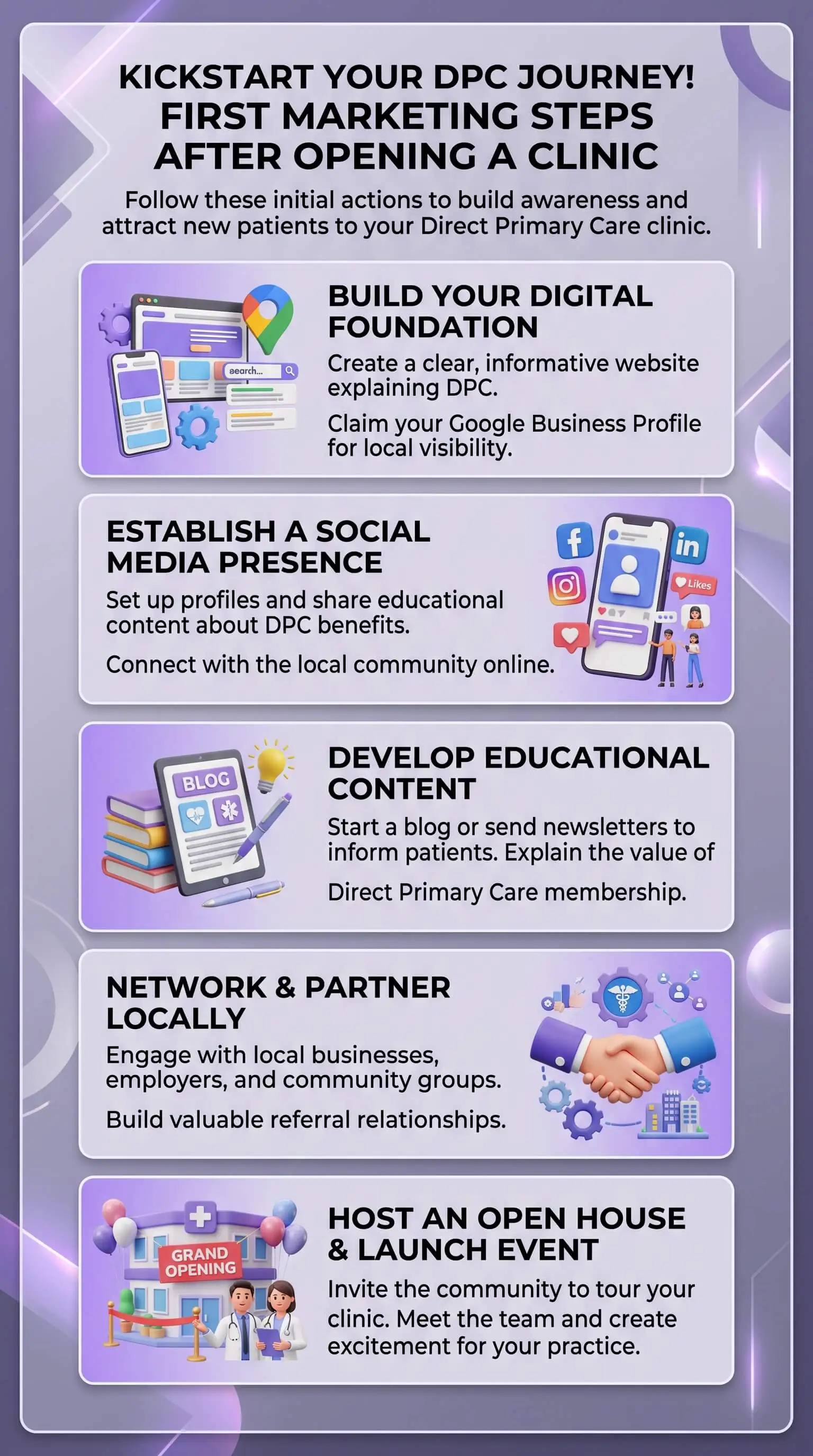
Days 1 through 30. Membership and pricing page live. Google Business Profile claimed and finished. DPC Frontier listing submitted. Ten to twelve hours of work.
Days 31 through 60. Five introductions to adjacent practitioners. Two small-employer conversations. A review request built into how you close a visit. Eight hours.
Days 61 through 90. One community talk. Welcome email sequence written. First monthly newsletter sent. Eight hours.
Then repeat days 31 through 90 and resist adding new channels. You don’t need all of it this quarter. You need the next right piece, done well.
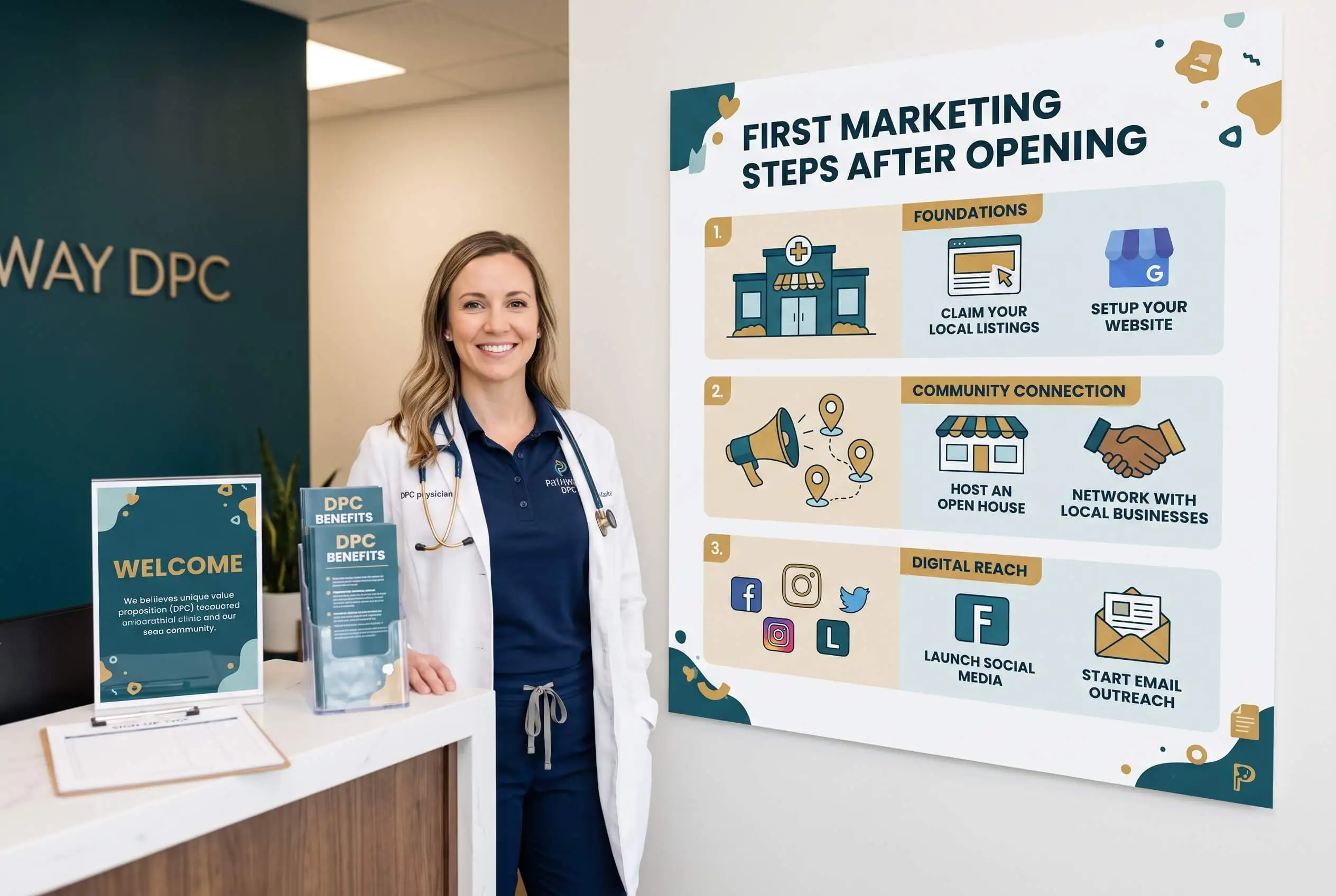
“I came to healthcare from writing launch campaigns where one badly worded page sinks the whole thing and there are no do-overs. That discipline travels. In a DPC practice every touchpoint does recruiting work, so none of them gets to be filler. And I’ll tell a doctor to go fix their pricing page and call me in a month rather than sell them a retainer they don’t need yet.”
Essential Resources
Seven things worth reading in your first ninety days. Skim the ones that match where you are this month. Every one is a primary source, meaning the academy, agency, or regulator that actually writes the rule.
Understand The Model You’re Selling
Get the model’s own language straight before you write a word of copy. The AAFP covers what a membership fee usually includes, how DPC differs from concierge care, and what to expect once you’re running.
Source: American Academy of Family Physicians
Get On The Map Patients Actually Search
People researching direct primary care come here to find a practice near them. Listing is free and verification takes about a day. Skip it and you’re invisible in a channel made entirely of intent.
Source: DPC Frontier Mapper
Set Up Your Google Listing Without Getting Suppressed
The rules covering business names, categories, and descriptions run tighter than most people assume, and breaking them can hide your profile outright. Read this once before you touch your listing.
Source: Google Business Profile Help
Know When Patient Information Needs Permission
Federal guidance on what counts as marketing under the HIPAA Privacy Rule, and when you need an authorization first. Read it before you publish a single patient story or photo.
Source: U.S. Department of Health and Human Services
Keep Your Claims Inside Professional Ethics
The AMA holds that almost nothing restricts physician advertising except the rules protecting the public from deception. This opinion shows where that line sits, especially around implying certainty of results.
Source: AMA Code of Medical Ethics
Collect Reviews Without Breaking Federal Rules
The FTC’s rule on fake and incentivized reviews took effect in October 2024. It covers paid-for sentiment, insider reviews, and review suppression. Worth knowing before you build any review program.
Source: Federal Trade Commission
Send Patient Email Legally
Accurate headers, honest subject lines, a working unsubscribe, and ten business days to honor an opt-out. The requirements are simple. The per-message penalties are not.
Source: Federal Trade Commission
These trusted resources help you build a compliant, patient-focused marketing foundation, whether you manage it yourself or work with a professional marketing agency that understands direct primary care.
Supporting Statistics
Three numbers worth knowing before your next marketing decision. I checked each against its original source rather than repeating it secondhand.
1. The average direct primary care panel is 413 patients.
This is the most clarifying number in DPC marketing, because it turns an abstraction into arithmetic. You’re not chasing traffic. You’re recruiting a countable group of people, and at a typical membership fee that group is your entire business. Which also means you can win them one honest conversation at a time.
Source: American Academy of Family Physicians, 2024 direct primary care data brief
2. Roughly 99% of DPC practices offer same-day appointments.
Read that one carefully, because it cuts against the obvious conclusion. Access isn’t what separates you from the DPC practice one town over, since nearly all of them offer it too. It’s what separates you from the insurance-based clinic booking three weeks out. Aim your messaging at the wait, not at your peers.
Source: American Academy of Family Physicians, 2024 direct primary care data brief
3. More than 3,100 DPC practices now sit on the DPC Frontier mapper.
As of July 2026 the mapper showed 3,131 practices across all fifty states plus Washington, DC, and the count keeps climbing. Two things follow. Patients have built a directory habit, so absence from the map is a real hole. And you’re no longer explaining a novelty. You’re explaining why you, specifically, in your town.
Source: DPC Frontier Mapper
These numbers reinforce that DPC growth depends on clarity, trust, and patient education—principles that ESG brand marketing and advertising agencies and healthcare marketers alike can apply to build lasting relationships.
Final Thoughts And Opinion
Here’s my bottom line, and I say it as someone who turns away wrong-fit clients. Most newly opened DPC practices don’t need a marketing budget. You need four pages that tell the truth clearly, a claimed listing on two maps, and the nerve to ask satisfied members for a review.
That’s the list.
The temptation in month one is to do everything, because doing everything feels like working. Usually it’s a way of dodging the one genuinely hard task, which is writing down what your practice costs and what it gives in language a nervous forty-two-year-old can absorb in ninety seconds. That document is your marketing. The rest is distribution.
Four hundred or so people. Small enough that word of mouth can carry you there, and a slow build is exactly what a membership model rewards. If your first ninety days feel unglamorous, you’re probably doing it right.
Frequently Asked Questions
Q: How Long Before A New DPC Clinic Starts Getting Patients?
A: Most practices see steady enrollment start somewhere in months three to six, once the website converts and local referral relationships have had time to produce. Your first month will almost certainly feel slower than you expected. That isn’t a sign the model is wrong.
Q: How Much Should A New DPC Clinic Budget For Marketing?
A: Less than you think, and mostly on the website. In your first ninety days the highest-return spending goes to a membership page that converts. Directory listings, your Google profile, community talks, and practitioner introductions cost time instead of money.
Q: Do DPC Clinics Need To Run Paid Ads?
A: Rarely at the start. A membership model rewards rankings and referrals that compound, while an ad budget resets to zero the day you stop paying. Ads make more sense later, for a second location or a specific enrollment push.
Q: What’s The First Thing To Fix On A DPC Website?
A: The pricing and membership page, or the fact that you don’t have one. If a visitor can’t find what you charge and what it covers in under a minute, everything upstream of that page is wasted effort.
Q: Can I Use Patient Testimonials In My Marketing?
A: Yes, with written authorization. HIPAA requires permission before any identifying patient information goes public, and the FTC prohibits incentives tied to positive sentiment. Unprompted public reviews you don’t answer by name are the safest ground.
Q: How Do I Explain The Membership Fee To A Skeptical Patient?
A: Compare it to what they already pay instead of to zero. Set the monthly figure against one specialist copay, an urgent care visit, or their deductible, then show the visit length and access it buys. Skepticism is usually about value clarity, not price.
Q: Should I List My Practice In DPC Directories?
A: Yes, and early. Directory traffic is small but almost purely intent-driven. These are people already sold on the model who just need someone nearby. Listing is free and takes about a day.
Ready To Fill Your Panel?
Your doors are open and your future members are already searching. The only question is whether your practice is the clear, trustworthy answer they find.
Start with the page that explains the money. Get on both maps. Ask your happiest members to say so publicly. Let those three work before you add anything else.
If you’d rather not write it yourself, that’s what I do. I handle the words for direct primary care and independent practices through medical healthcare copywriting services, meaning web copy, local search content, and email, on a sliding scale, with a few openings held each quarter for new and small practices. Grab a free fifteen-minute call and tell me where your panel is stuck. You can also see how I approach DPC and physician marketing help first. If it turns out you need something I don’t do, I’ll tell you who to call.