Yes, and the help starts months before your slow season does. An outsourced accounting team forecasts your cash across the full year, times payroll and bills to your revenue curve, and sets a reserve target while peak-season money is still coming in. You stop reacting to the off-season and start planning for it.
Think about a landscaping company in February. The trucks are parked and the crews are thin, yet rent, payroll, insurance and the equipment loan all come due on the first of the month. Revenue arrives in a handful of strong months, while the bills arrive every month. When nobody plans for that gap, the busy season ends up paying for panic in the quiet one.
Accounting outsourcing means handing some or all of your financial operations to an external team, from bookkeeping and payables to payroll, the monthly close, reporting and forecasting. For a seasonal business, forecasting is where outsourced accounting services for growth earn their keep.
TL;DR Quick Answers
Outsourced Accounting Services for Growth
Outsourced accounting services for growth give your business an external finance team that runs the monthly close, forecasting, reporting and internal controls, without the cost of building an in-house department. Where bookkeeping records what already happened, outsourced accounting plans for what comes next.
What's included: transaction management, reconciliations, accounts payable and receivable, payroll integration, the monthly close, budgeting, forecasting and custom reporting.
Why it supports growth: support scales with your transaction volume, so you don't have to time a new hire to every growth spurt.
Why a team beats one hire: you get broader skills and built-in backup, while a single in-house accountant is a single point of failure.
When it fits: revenue is outpacing your systems, closes run late, numbers conflict across platforms, or an audit or financing round is coming up.
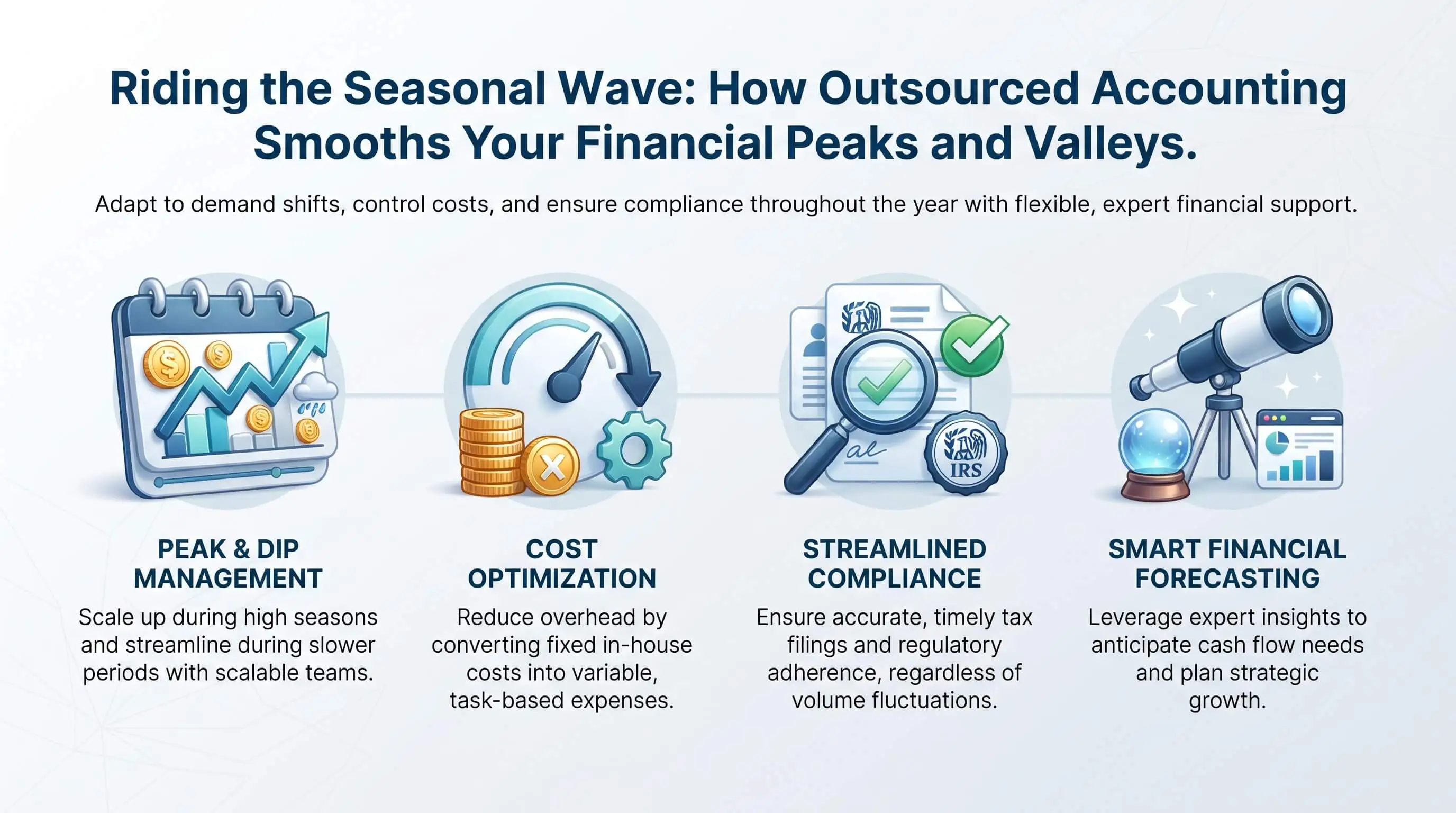
For seasonal businesses: a rolling 12-month forecast and a reserve target turn the slow season into a planned line item.
Cost and timing: usually a fraction of a full-time hire. Accountix Solutions starts at $350 per week, and most clients are fully onboarded in about four weeks.
Top Takeaways
Forecast the full year, not just next month, and update it as actual numbers come in.
Set your off-season reserve target during peak season, while cash is still coming in.
Time payroll, payables and inventory purchases to your revenue curve instead of the calendar.
Bookkeeping is your foundation, but forecasting and reporting are what carry a seasonal business through the slow months.
Plan marketing spend from your cash forecast so pre-season campaigns don't drain your reserves.
Why Seasonal Revenue Breaks Basic Bookkeeping
Bookkeeping tells you where your money went. It records transactions, reconciles accounts and keeps the books clean, and every strong finance function is built on that work.
Last month rarely hurts seasonal business, though. The damage comes from what's six weeks out, and it usually shows up in one of these places:
Cash runs short in the off-season, even after a profitable year.
Peak-season hiring grows faster than the revenue meant to cover it.
You buy inventory or materials up front with no plan for paying for them.
The monthly close slips when transaction volume spikes, so your team makes peak-season decisions on stale numbers.
Most owners also have less room than they think. JPMorgan Chase Institute's 2025 data shows the median small business holds 17.6 cash buffer days, which is roughly two and a half weeks of expenses if revenue stopped tomorrow. For a business whose revenue slows for months at a time, that isn't much of a cushion.
How Outsourced Accounting Smooths the Peaks and Valleys
Rolling Cash Flow Forecasts Built on Your Seasonal Curve
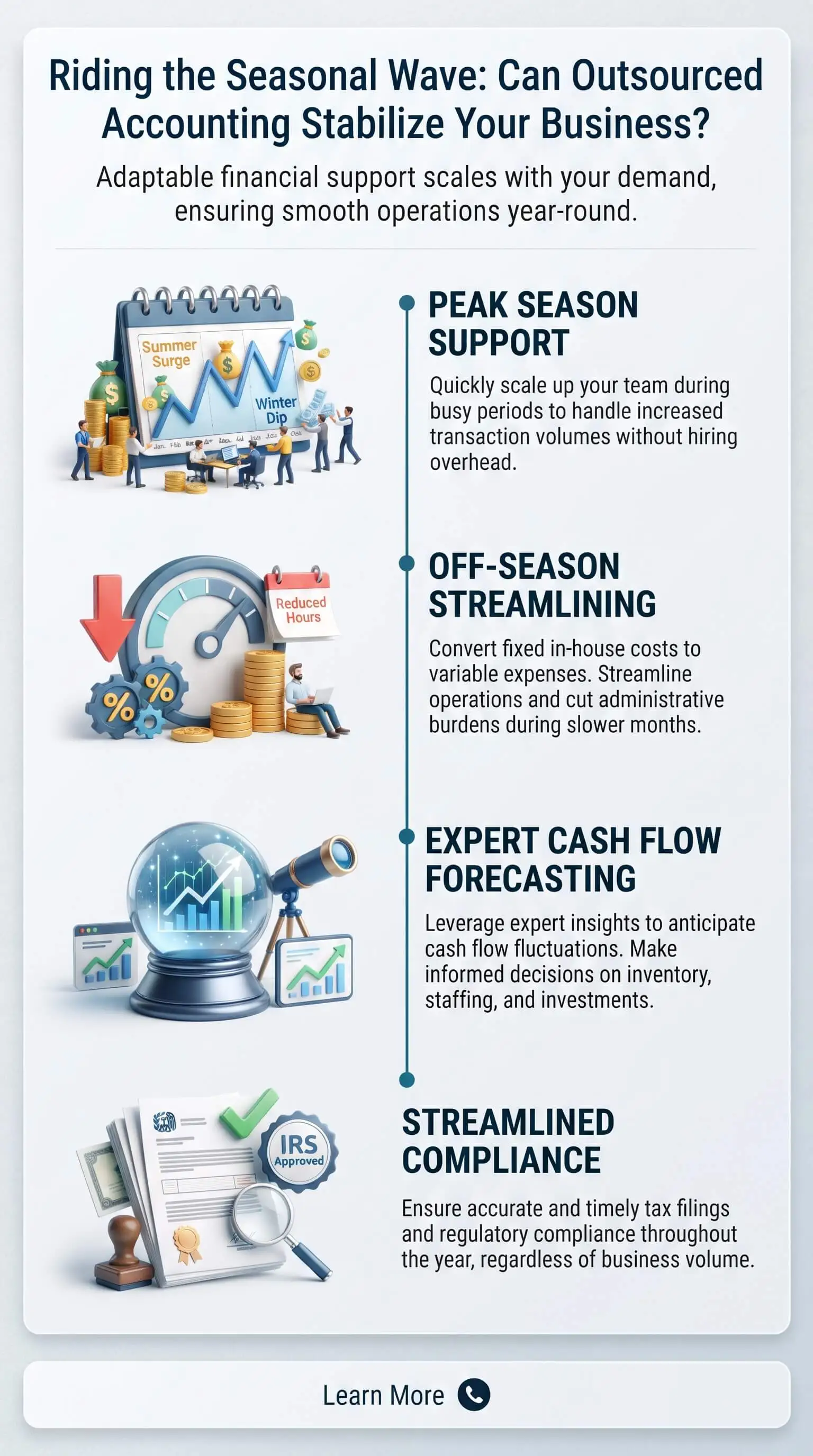
When you hire an outsourced accounting firm, a strong outsourced team builds a 12-month cash forecast from your own history and updates it every month. A 13-week forecast sits underneath it for near-term calls. Unlike a budget, the forecast follows the date cash lands in your account, not the date you booked the sale. If a customer pays 45 days after a June job, that money shows up in August.
Reserve Targets Set Before the Slow Season
Cash buffer days turn a vague worry into a number you can manage. Divide your cash balance by your average daily spending and you know how long the business could run with no new revenue. Your accountants then work backward from the length of your slow season to a reserve target and set aside a share of peak revenue to hit it.
Payables, Payroll and Inventory Timed to Revenue
Payroll is usually your largest recurring outflow, so it gets planned first. An outsourced accounting team maps seasonal staffing costs months ahead and negotiates vendor terms that match your revenue cycle. It also sequences payables so the big bills miss your leanest weeks.
Off-Season Budgeting and Credit Planning
Open a line of credit when you don't need one. Lenders want clean, current financials and a forecast that proves you understand your own cycle, and both are far easier to produce in July than in January. Outsourced accountants also schedule your big off-season projects, like equipment repairs, upgrades and staff training, so you fund them on purpose instead of improvising.
A Month-End Close That Holds Up in Peak Season
When transaction volume triples, one in-house bookkeeper falls behind. A team spreads the load and keeps the close on schedule. That way, your peak-season decisions run on current numbers instead of last month's.
Bookkeeping vs. Outsourced Accounting for a Seasonal Business
Recording transactions: bookkeeping handles it, and so does outsourced accounting.
Account reconciliations: bookkeeping handles it, and so does outsourced accounting.
Processing bills and invoices: bookkeeping handles the processing. Outsourced accounting also times each payment to your cash cycle.
Monthly close: sometimes part of bookkeeping. Outsourced accounting runs it on a set schedule.
Budgeting and forecasting: outside the scope of bookkeeping. Included with outsourced accounting.
Cash reserve planning: outside the scope of bookkeeping. Included with outsourced accounting.
Internal controls: outside the scope of bookkeeping. Included with outsourced accounting.
Management reporting: bookkeeping offers basic reports. Outsourced accounting adds season-over-season trends.
When Outsourced Accounting Services for Growth Make Sense
Seasonality and growth tend to collide. Every peak runs bigger than the last, transaction volume climbs, and the system that worked when you were half the size starts to crack. Watch for these signs:
Each peak season is bigger than the last, and so is the scramble that comes with it.
Your books close weeks late, or not at all, during your busy months.
Your bank, payroll and accounting platforms show conflicting numbers.
Someone on your leadership team asks whether you can afford something, and nobody can answer with confidence.
An audit, loan application or investor conversation is coming up.
You need controller-level work but can't justify a full-time salary yet.
If several of these sound familiar, outsourced accounting services for growth give you forecasting, a dependable close and reporting you can act on, without the cost of building a finance department. Accountix Solutions, for example, builds its service around the tools and processes you already use. Its team works in QuickBooks Online alongside platforms like Bill.com, Gusto and Ramp, and most clients are fully onboarded within about four weeks.
Cost matters too. A full-time accountant brings salary, benefits, payroll taxes, software and training costs with them. One hire is also one point of failure. If that person leaves in March, your peak season starts without anyone who knows the books, while an outsourced team providing professional accounting services gives you broader skills and built-in backup for a fraction of the cost.
Planning Marketing Spend Around Seasonal Cash
Peak-season campaigns run before peak revenue arrives, so you're spending cash you haven't collected yet. That's where finance and marketing meet. A cash forecast shows you how much ad spend is safe and when to commit it.
A few rules that hold up in practice:
Lock in your pre-season marketing budget at the same time you set your reserve target.
Run a lighter shoulder-season budget instead of going dark, since staying visible costs less than starting over.
If you keep an agency on retainer, build its fee into the off-season forecast so it isn't the first thing you cut.
Weighing whether agency support is worth the money? Our guides on the benefits of working with a professional marketing agency and whether digital marketing is worth it cover that side. Your accounting forecast answers the other half, which is what you can afford and when.
"While most of the seasonal businesses we work with earn enough over a full year, very few of them see the slow months coming. In our experience, the first rolling forecast we build is often the first time an owner sees the off-season in writing, with dates and dollar amounts attached. From that point on, the conversation shifts from how to get through January to how much to set aside in July. That shift does more for a seasonal business than any single cost cut we could recommend."
7 Essential Resources
Accounting outsourcing, Wikipedia: a plain-language overview of what outsourcing covers, how it developed and the models firms use today.
Cash is King: Flows, Balances, and Buffer Days, JPMorgan Chase Institute: the study that introduced cash buffer days, built on data from 600,000 small businesses and broken out by industry.
Small Business Payroll, JPMorgan Chase Institute: how payroll shapes cash reserves for small employers. Read it before you plan seasonal staffing.
Small Business Credit Survey 2026: Insights Into the Third District, Federal Reserve Bank of Philadelphia: recent survey data on uneven cash flow, operating costs and borrowing.
Small Business Credit Survey on FRED, Federal Reserve Bank of St. Louis: the share of small employers reporting financial challenges each year from 2017 to 2025.
9 Cash Flow Management Tips for a Seasonal Business, FreshBooks: practical tactics for invoicing, payment timing and getting through the slow season.
How Outsourced Accounting Scales with Your Business, BPM: one firm's view on how outsourced accounting removes the hiring bottleneck as a business grows.
3 Statistics
17.6 days. Across 25 U.S. metro areas in 2025, the median small business held 17.6 cash buffer days, meaning it could cover its normal spending for about that long if revenue stopped. Medians ranged from 12.8 days in Orlando to 24.1 days in San Francisco. Source: JPMorgan Chase Institute.
18 days and 18%. The typical small business with employees carried just 18 cash buffer days, compared with 27 for small businesses overall. Payroll made up 18% of its outflows. Source: JPMorgan Chase Institute.
95%. In the Federal Reserve's 2025 Small Business Credit Survey, 95% of employer firms with less than $1 million in revenue reported at least one financial challenge over the previous 12 months. Uneven cash flow is one of the challenges the survey tracks. Source: Federal Reserve Banks via FRED.
Final Thoughts and Opinion
Surprise does more damage to seasonal businesses than seasonality itself. A company with dramatic swings can run calmly while a steady one lurches from crisis to crisis, and the difference usually comes down to whether anyone is looking ahead. The owners who handle lumpy revenue well decide in March what they'll do in October. They know their reserve target and the week payroll peaks. They also know how much marketing they can fund before the season pays for it.
That's my case for outsourced accounting. Clean books are the starting point. The value shows up in the forecast, in the calendar of decisions it creates and in a close that lands on time every month, busy months included.
To be fair, not every seasonal business needs a full outsourced team on day one. A very small operation with one predictable slow season can do fine with solid bookkeeping and a careful spreadsheet. Once the peaks get bigger and the stakes rise, though, outsourced accounting services for growth stop being optional, because they keep growth from turning into a cash crunch.
Frequently Asked Questions
Can outsourced accounting help a seasonal business manage cash flow?
Yes. An outsourced accounting team builds a rolling cash forecast around your seasonal pattern, sets a reserve target for the slow months and times payroll and payables to match revenue. You'll see a shortfall weeks or months ahead instead of finding it when your bank balance drops.
What is the difference between bookkeeping and outsourced accounting for seasonal revenue?
Bookkeeping records and reconciles your transactions, so it tells you where your money went. Outsourced accounting builds on that with the monthly close, budgeting, forecasting, internal controls and management reporting. For a seasonal business, forecasting and reserve planning are the pieces that keep the off-season from turning into a crisis.
How far ahead should a seasonal business forecast its cash?
At least 12 months, so you can see the full seasonal cycle, and you should update it every month with actual results. Add a rolling 13-week forecast for near-term decisions like payroll, vendor payments and campaign timing.
How much cash reserve does a seasonal business need?
There's no single right number. A practical approach is to estimate your expected shortfall across the slow season and then add a safety margin. Cash buffer days give you a useful benchmark. The median small business held about 17.6 days in 2025, and that's rarely enough when your off-season lasts several months.
Are outsourced accounting services for growth worth it for small businesses?
Often, yes, especially once your seasonal peaks grow and the books start falling behind. An outsourced team gives you forecasting, reporting and backup coverage for less than a full-time hire costs once you count salary, benefits, taxes and software. A very small, simple business may only need bookkeeping at first.
How long does it take to onboard an outsourced accounting team?
That depends on the provider and how complex your books are. Accountix Solutions, for example, says most of its clients are fully onboarded within about four weeks of kickoff. Start before your busy season so the systems are in place when transaction volume climbs.
How much does outsourced accounting cost?
Pricing depends on your transaction volume, your complexity and how much you need beyond bookkeeping, and it usually comes in at a fraction of a full-time in-house hire. As one example, Accountix Solutions lists outsourced accounting starting at $350 per week, with fixed pricing set after a discovery call.
Get Confidence in Your Numbers All Year
Your slow season is coming either way. You can spot it on a forecast months ahead, or you can find it in your bank balance. Through affordable outsourced accounting services for small firms, Accountix Solutions helps growing businesses replace reactive bookkeeping with forecasting, a dependable close and reporting you can act on. It all starts with a 30-minute intro call built around clarity, with no sales pitch attached.